Statements of Krauanagazan Government Officials and Offices

Enário te ti Taáriáenza Úvárak

Department of the Air Force
Statement on Airstrike Incident in Tanagra on Pohnarras
PRESS RELEASE


The Federal Air Force of Krauanagaz deeply regrets an unfortunate incident that occurred during an operation last night on Pohnarras Island, resulting in the loss of civilian lives and injuries to others. We extend our heartfelt condolences to the families affected by this tragedy and wish a speedy recovery to those injured - who have since been evacuated from the island.

The incident occurred during a significant spike in militant activity in the town of Tanagra, prompting the Federal Air Force to undertake a precision airstrike targeting a known militant stronghold on Pohnarras Island. Our forces acted per established protocols and intelligence reports, with the primary objective of neutralizing imminent threats to civilian safety and restoring peace and stability to the area. Unfortunately, despite our best efforts to accurately identify and target hostile elements, a tragic error occurred, leading to the misidentification of a group of fleeing civilians as militants. We deeply regret this unintended loss of innocent lives and are conducting a thorough investigation into the circumstances surrounding the incident to determine the cause and prevent such occurrences in the future.

The Federal Air Force remains committed to upholding the highest standards of professionalism and accountability in all our operations. We will work closely with federal and provincial authorities to support and assist the affected families, including compensation for damages and access to medical care and counseling services. As we mourn the loss of innocent lives, we reaffirm our unwavering commitment to ensuring the safety and security of all civilians in Krauanagaz and beyond. The Federal Air Force will continue to adapt and improve our operational procedures to minimize the risk of civilian casualties and uphold our duty to protect innocent lives in conflict zones.

We thank the public for their understanding and patience as we navigate this challenging situation and pledge to learn from this tragedy to prevent similar incidents in the future.

Signed,

Secretary of Defense
Haratal N’gevayya

Secretary of the Air Force
Soren Lukos

Chief of Staff of the Air Force
General Dario Kaorez

1 Like

Enário te Temivenzhir, 'a Enário te Temivenzhir

Department of State
Invitation to a State Visit
Diplomatic Communique to @KingTEM


To His Majesty King Joshua VII,

General John Nielson,

and Captain John Jackson of the ERNS Victorious,


On behalf of the Government and the People of Krauanagaz, it is with great honor and esteem that I extend to you an invitation for a state visit to the Krauanagaz Federation.

Recognizing the historical ties and shared interests between our two nations, a state visit presents an exceptional opportunity to reinforce the bonds of friendship, discuss matters of mutual importance, and explore avenues for enhanced cooperation and partnership.

During your visit, we envision engaging in substantive discussions covering a broad spectrum of topics, including economic collaboration, defense cooperation, cultural exchange, and regional stability. Your esteemed presence would undoubtedly contribute to the advancement of our bilateral relations and deepen the understanding between our nations.

Moreover, we extend our warm invitation for you to immerse yourselves in the rich cultural heritage, scenic landscapes, and hospitality of Krauanagaz. From the majestic mountains to the bustling cities, there is much to discover and appreciate in our diverse nation.

In preparation for your visit, our government is committed to ensuring that all necessary arrangements are made to facilitate a successful and memorable visit for your delegation. We eagerly anticipate the opportunity to host you and your esteemed delegation in Krauanagaz and to further strengthen the enduring ties between our nations.

Please convey our sincere regards to the government and the esteemed citizens of the United Kingdoms of Emerald and Denver.

Signed,

Temiprizhirven te ti Krauanaet
Lyra Zharan

Enário te Temivenzhir
Darius Korin

2 Likes

Zhirveniayya Temipre te Kallzhir Uvenital

Federal Human Rights Commission
Condemnation of Discriminatory Laws in Akarina
Statement


The Krauanagaz Federal Human Rights Commission (FHRC) expresses its profound dismay and condemnation regarding the recent enactment of discriminatory laws in Akarina. These laws, which criminalize same-sex sexual activity and prohibit legal gender changes, represent a severe violation of fundamental human rights and freedoms.

The new legislation, which penalizes same-sex sexual activity with up to five days in jail and a 6,000-Rū fine, is a blatant attack on the LGBTQ+ community. This law not only infringes on the basic rights of individuals to express their identities and love freely but also perpetuates a culture of discrimination and intolerance that Southern Cordilia knows all too well. The FHRC stands firmly against any form of legislation that seeks to marginalize and oppress individuals based on their sexual orientation or gender identity.

Furthermore, the prohibition on legal gender changes is a retrogressive measure that denies individuals the right to self-identify and live authentically. By dismissing the legitimate concerns and needs of transgender and non-binary individuals, the Akarinan government is woefully disregarding the principles of dignity, respect, and equality that should be the cornerstone of any just society. The government’s statement asking people to worry about “actual issues” is not only dismissive but also undermines the lived experiences and struggles of countless individuals seeking only recognition and acceptance.

The FHRC calls upon the Akarinan government to repeal these unjust laws immediately and to uphold the universal principles of human rights and equality.
Human rights are universal and indivisible, and the FHRC remains committed to advocating for the rights of all people. We stand in solidarity with the LGBTQ+ community at home, in Akarina, and around the world. Our commitment to fight against discrimination and to promote equality and justice for all stands unwavering.

Signed,

Zhirveniayya Temipre te Kallzhir Uvenital
High Commissioner for Human Rights
Elowen Serak

2 Likes

Temiprizhirven te ti Krauanaet

Office of the Krauanaet
Addressing the National Emergency Declaration
Transcript of Delivered Statement


Good evening, my fellow Krauanagazans,

Tonight, I stand before you during a time of great uncertainty for our nation. Recent events domestically have tested our resolve and have left us with heavy hearts and anxious minds. I want to assure you that your government is working tirelessly to navigate these challenging times and to protect our people and our way of life.

Over the past few days, we have witnessed a series of troubling incidents that have escalated tensions and threatened our national security and that of Mitallduk. On the morning of May 21, our State Department lost contact with our embassy in Mitallduk, following an emergency alert from the embassy’s security system. Despite numerous attempts, we have been unable to re-establish communication with our diplomatic staff. This was preceded the night before by an explosion at the Mitallduk Confederacy Refugee Office in Ta’ana, fortunately with no reported injuries.

Moreover, we have received reports of increasing violence and instability along our border with Mitallduk. Gunshots and explosions have been heard, and our defense officials have taken necessary actions to secure the border areas. Tragically, we have also confirmed the death of Daman Kullan, who was killed by rogue elements while attempting to evacuate to Krauanagaz.

These events have led to a surge of refugees crossing into Northern Krauanagaz, seeking safety from the conflict engulfing Mitallduk. We are witnessing a humanitarian crisis unfold, and we urge the international community to send whatever aid can be spared.

In response to these developments, we have taken several decisive actions to safeguard our nation. We have moved to DEFCON 3, an elevated level of military readiness, and have recalled all servicemembers to their units. Our air defense systems in Northern Krauanagaz have been activated, and civilian air traffic is being rerouted to ensure safety. After coordination with the Ludoraiya, a national state of emergency has been declared to expand the powers of the office of the Krauanaet, allowing us to more effectively and quickly respond to the crises afflicting our nation.

We are working diligently to secure our borders and to provide aid and support to those fleeing the violence in Mitallduk and Southern Krauanagaz. Our immediate priority is to ensure the safety of our citizens and diplomatic staff and to restore communication and stability.

We are in close communication with our international allies and organizations, seeking their support and cooperation during this critical time. It is imperative that the global community stands together in the face of such challenges. I would like to thank our friends and partners in the South Cordilian Counterterrorism Task Force, who play vital roles in efforts to restore peace and order in Southern Cordilia.

I urge all citizens of Krauanagaz to remain calm and united. Our strength lies in our unity and our resilience. Let us stand together, support one another, and demonstrate the unyielding spirit that defines our great nation. Cooperation with local authorities and adherence to safety guidelines are essential as we navigate through these turbulent times.

Rest assured, your government is fully committed to addressing this situation with the utmost diligence and care. We are exploring all avenues to ensure the safety of our diplomatic staff and citizens and to bring about a swift resolution to this crisis. We will continue to monitor the situation closely and take all necessary actions to protect our nation and its people.

Together, we will overcome these challenges and emerge stronger. I have full confidence in our ability to navigate through this crisis, securing a better future for all.

Thank you, and may Krauanagaz forever stand united.


Office of the Krauanaet
Krauanaet Lyra Zharan

Enário te Temivenzhir

Department of State
Statement
For Immediate Release


We are appalled and deeply troubled by the recent raid on Pasture’s offices in Mitallduk, as reported to us by the organization. Such brazen acts of aggression against avenues of speech and media outlets are not only reprehensible but also a direct assault on the fundamental principles of free speech and expression.

The detention of Pasture’s staff members who are not Mitalldukish citizens is a grave violation of their rights and a clear infringement on the freedoms that we hold dear. We condemn this unjust and violent action in the strongest possible terms and demand the immediate release of all detained individuals.

Furthermore, we have received alarming reports indicating that our own diplomatic staff and ambassador to Mitallduk have too been detained by a force identifying themselves as the ‘Takaran People’s Army.’ This development is deeply concerning and raises serious questions about the safety and well-being of our personnel.

We still have not had any communications with recognized authorities in Mitallduk however we are working tirelessly to make contact and secure the release of our detained colleagues.

The Krauanagazan government stands in solidarity with Pasture, its employees, and all individuals who have been unjustly detained or subjected to violence. We will continue to closely monitor the situation and will provide updates as we receive more information.

Our thoughts are with all those affected by these distressing events, and we remain committed to upholding the principles of democracy, freedom, and human rights, both at home and abroad.

Signed,

Enário te Temivenzhir
Darius Korin

Enário te Temivenzhir

Department of State
Statement
For Immediate Release


We categorically refute the portrayal of the situation in Krauanagaz as a “black hole” by Kliegmean officials. Such characterization not only lacks nuance, but also fails to acknowledge the multifaceted challenges facing our nation amid the ongoing regional crisis.

We acknowledge the significant contributions made by the Starhawk Pact, @Kliegme, and other nations in providing both military and humanitarian aid. This support has been invaluable and is deeply appreciated by the people of Krauanagaz. However, it is crucial to recognize that the situation in Krauanagaz is not simply a matter of receiving aid but involves a multifaceted and dynamic set of challenges that require time, perseverance, and continued cooperation to address effectively.

The Krauanagazan government has been working tirelessly to stabilize the nation amidst crisis after crisis, fueled by deep-rooted regional instability, cross-border and domestic militant activities, and a significant humanitarian burden due to the influx of refugees from Mitallduk and Southern Krauanagaz. Despite the considerable efforts and resources dedicated to these issues, the sheer scale and rapid onset of the problems have made macro improvements difficult.

Contrary to the claims of ‘governmental foresight’ by Kliegmean officials in their withdrawl, Krauanagaz remains committed to upholding its responsibilities to its citizens and our international guests. The assertion that our government has been ineffective in utilizing international aid is not only misleading, but also dismisses the substantial progress made in several key areas, including the provision of essential health services, the protection of civilians, and the strengthening of our national security infrastructure evident in the defense of Alkantara and the liberation of Pohnarras Island.

Kliegme’s decision to hastily withdraw assets and citizens from Krauanagaz, which was insulting to the people of Krauanagaz, cannot be retroactively upheld as a display of ‘governmental foresight.’ Such revisionist framing conveniently ignores the complexities and uncertainties inherent in crisis situations and disregards the ongoing efforts of the Krauanagazan government to address the challenges at hand. The withdrawal was nothing short of tucking tail and running off, no other nation has taken such drastic action aside from Zuhlgan— whose diplomatic outposts are being targeted.

We reject any insinuation that Krauanagazan authorities have failed to improve the situation despite international aid. The reality is that our nation continues to grapple with security, economic, and humanitarian challenges exacerbated by regional instability and militant threats. We urge our international partners, including Kliegme, to continue to stand with Krauanagaz during this dire time. Abandoning the collaborative efforts and solidarity that have been the backbone of our approach thus far will only serve to exacerbate the crisis and prolong the suffering of innocent people.

Despite the setbacks and obstacles we face, we remain committed to transparency, accountability, and effective use of resources. We invite Kliegmean officials and representatives from other nations to engage in constructive dialogue and to witness firsthand the ongoing efforts and challenges on the ground. By working together, we can foster a more accurate understanding of the situation and develop more effective strategies for long-term stability and prosperity in the region.

Krauanagazan State Department will continue to work tirelessly to address the needs of our people and to build a brighter future for all.

Signed,

Enário te Temivenzhir
Darius Korin

1 Like

Zhirveniayya Temipre te Kallzhir Uvenital

Federal Human Rights Commission
Office of Criminal Investigations and Justice


Federal Human Rights Commission Findings on Pohnarras Island

Date: May 31, 2024

Introduction

The primary objective of the OCIJ investigation on Pohnarras Island was to determine the veracity and extent of allegations of war crimes and crimes against humanity. The scope of this OCIJ investigation was limited to Pohnarras Island and the surrounding waters, focusing on incidents that occurred between February 22, 2024, and May 8, 2024. The investigation concentrated on the regions of Arrasos, K’larain, Bataklasos, Tagara, Tanagra, and Parnasos.


Executive Summary

The OCIJ found multiple violations of international humanitarian and conflict law by various parties, including Red K (RK), the Messengers of Tallaz (MOT), the Zuhlgani Air Force, and the Kevpríg Provincial Militia.

Key findings include:

  • Massacres of ethnically Mitalldukish citizens by MOT militants in Tagara, Tanagra, and Parnasos.
  • Killing of detained militants by Kevpríg Provincial Militia in Parnasos and Arrasos.
  • An airstrike in K’larain by the Zuhlgani Air Force that killed seven noncombatants and injured ten others.
  • Arbitrary executions of individuals who refused to identify Mitalldukish neighbors by RK and MOT in Bataklasos, Tagara, Tanagra, and Parnasos.
  • Prolific arson attacks by RK and MOT in Bataklasos.

Methodology

  1. Evidence Collection:
  • Interviews: Conducted interviews with survivors, witnesses, and local officials.

  • Document Analysis: Reviewed medical records, death certificates, and official reports.

  • Field Visits: Visited affected areas to gather physical evidence and assess the extent of damage.

  1. Evidence Analysis:
  • Cross-referenced testimonies with physical evidence and documented reports.

  • Collaborated with forensic experts to analyze injury patterns and causes of death.

  1. Challenges and Limitations:
  • Intimidation of witnesses by militant groups hampered comprehensive testimony collection.

  • Lack of cooperation from Zuhlgani authorities.


Findings

1. War Crimes:

  1. Massacres of Ethnically Mitalldukish Citizens:
  • Tagara: In Tagara, the investigators documented a series of coordinated attacks by MOT militants, resulting in the deaths of at least 85 Mitalldukish civilians. Eyewitness accounts and forensic evidence confirmed the systematic targeting of this ethnic group.

  • Tanagra: In Tanagra, 67 Mitalldukish civilians were killed in a massacre by MOT militants. Survivors recounted that militants used small arms and improvised explosive devices (IEDs) to carry out these attacks inside homes and in the streets.

  • Parnasos: In Parnasos, 53 Mitalldukish civilians were confirmed killed. Forensic analysis corroborated reports of executions, with many victims found with gunshot wounds to the head and signs of torture.

  1. Executions by Kevpríg Provincial Militia:
  • Parnasos: In Parnasos, the Kevpríg Provincial Militia was found to have executed 24 detained militants. Witnesses described how detainees were taken from holding cells and shot at close range.

  • Arrasos: In Arrasos, the Kevpríg Provincial Militia executed 15 detained militants. Testimonies indicated that the executions were carried out without any judicial process, and bodies were disposed of in mass graves that were excavated by investigators.

  1. Airstrike by Zuhlgani Air Force:
  • K’larain: An airstrike in K’larain by the Zuhlgani Air Force resulted in the deaths of seven (7) noncombatants and injuries to ten (10) others. Investigations revealed that it is probable that the Zuhlgani Air Force was aware they were conducting a bombing of a civilian area. Forensic evidence collected at the site was consistent with Zuhlgani aerial munitions.

2. Crimes Against Humanity:

  1. Arbitrary Executions:
  • Bataklasos: RK and MOT militants executed individuals who refused to identify Mitalldukish neighbors. Witnesses recounted seeing militants go door-to-door, demanding information and executing those who refused to comply. At least 30 civilians were confirmed to have been killed in these executions.

  • Tagara, Tanagra, Parnasos: Similar patterns of arbitrary executions were documented in these regions. In total, 94 civilians were executed across these areas for their refusal to cooperate with RK and MOT militants.

  1. Arson Attacks:
  • Bataklasos: RK and MOT militants carried out widespread arson attacks, destroying homes, schools, and hospitals. Investigators found evidence of incendiary devices used to start fires, which led to the destruction of approximately 200 buildings and the displacement of over 2,000 residents. At least 137 individuals are confirmed to have been killed in the flames, a majority of which remain unidentified at this time.

3. Impact on Civilians:

  • Survivor Testimonies: Collected detailed accounts from survivors and witnesses, highlighting the traumatic impact on civilians.

  • Humanitarian Crisis: Noted severe shortages of food, water, and medical supplies in affected areas due to the conflict.


Legal Analysis

These acts constitute gross violations of the Grovne Convention and additional protocols. These acts, too, are breaches of national criminal statutes related to murder, arson, torture, and unlawful detention.

Identified individuals and groups responsible for war crimes and crimes against humanity must be held accountable through legal action in national and international courts. To such effect, the OCIJ recommends the following individuals be charged by the relevant authorities:

  1. Alkan Rasha (Red K Pohnarras Leader):
  • Charges: War crimes, crimes against humanity, murder, torture, arson, and unlawful detention.
  • Details: Alkan Rasha is alleged to have orchestrated and overseen the arbitrary executions and arson attacks carried out by Red K militants in Bataklasos, Tagara, Tanagra, and Parnasos.
  1. Aarin Talov (Messengers of Tallaz Commander):
  • Charges: War crimes, crimes against humanity, murder, torture, and arson.
  • Details: Jarin Talov is implicated in the massacres of ethnically Mitalldukish citizens in Tagara, Tanagra, and Parnasos, and for directing MOT militants in carrying out arbitrary executions and arson attacks.
  1. Colonel Eran Zulet (Zuhlgani Air Force):
  • Charges: War crimes, murder.
  • Details: Colonel Eran Zulet authorized and executed the airstrike in K’larain that resulted in the deaths of seven noncombatants and injuries to ten others, violating international humanitarian law by targeting a civilian area.
  1. Captain Irana Vesh (Kevpríg Provincial Militia):
  • Charges: War crimes, crimes against humanity, murder, and torture.
  • Details: Captain Irana Vesh is accused of ordering and participating in the executions of detained militants in Parnasos and Arrasos, as well as engaging in acts of torture.
  1. Second Lieutenant Harik Zhin (Kevpríg Provincial Militia):
  • Charges: War crimes, crimes against humanity, murder, and torture.
  • Details: Second Lieutenant Zhin, leader of the Kevpríg Provincial Militia First Battalion, Second Company, Third Platoon, is implicated in the unlawful execution of detained militants and the torture of prisoners of war in Parnasos and Arrasos.
  1. Lieutenant Rako Timar (Red K):
  • Charges: War crimes, crimes against humanity, murder, and arson.
  • Details: Lieutenant Rako Timar is accused of leading Red K units in carrying out arson attacks and arbitrary executions in Bataklasos, resulting in significant civilian casualties and property destruction.
  1. Lieutenant Faran Dekar (Messengers of Tallaz):
  • Charges: War crimes, crimes against humanity, murder, and torture.
  • Details: Major Faran Dekar played a key role in the massacres in Tanagra and Parnasos and is implicated in the systematic targeting of Mitalldukish civilians and the use of torture.

It is the OCIJ’s view that prosecuting offenders under national laws where feasible should take precedence. However, in some high-profile cases, referrals to international criminal courts may be in order. The following cases are recommended for international prosecution due to their severity and/or the need for impartial adjudication:

  • Alkan Rasha and Jarin Talov for orchestrating and executing widespread atrocities.

  • Colonel Eran Zulet for the unauthorized and indiscriminate airstrike resulting in civilian casualties.


Recommendations

The OCIJ has notified the appropriate National and International authorities
regarding our findings in the investigation on Pohnarras Island. It is the view of the OCIJ that these cases be treated with the utmost urgency and gravity due to the severe nature of the crimes committed. The following recommendations are made to ensure justice is served:

1. Legal Actions:

  1. The OCIJ recommends that the Krauanagazan government immediately initiate criminal proceedings against the identified individuals, leveraging national laws that address war crimes, crimes against humanity, murder, arson, torture, and unlawful detention. It is crucial for the national judicial system to work in close collaboration with the OCIJ to gather and present irrefutable evidence, ensuring that the trials are conducted transparently and adhere to the highest standards of justice.

  2. For cases involving high-profile suspects and where national prosecution may face limitations, the OCIJ advocates for referrals to the International Court (IC). This includes suspects like Alkan Rasha and Aarin Talov, whose actions have had a widespread and devastating impact on civilian populations. The OCIJ will provide comprehensive dossiers of evidence to the IC to support these prosecutions and facilitate international cooperation in apprehending and trying the accused.

  3. In instances where suspects have fled or are residing in foreign territories, the OCIJ recommends the Krauanagazan government issue formal extradition requests.

  4. The OCIJ advises the establishment of robust witness protection programs to safeguard the testimony of survivors and witnesses who can provide critical evidence against the accused. Ensuring their safety and anonymity is paramount to securing reliable and comprehensive testimonies.

2. Policy Changes:

  1. The OCIJ recommends regular training and sensitization programs for military and law enforcement personnel on international humanitarian law and human rights standards should be instituted to prevent abuses.

  2. The OCIJ strongly recommends establishing independent monitoring bodies to oversee military and police operations in conflict-prone areas to aid in early detection and prevention of potential human rights violations. These bodies should have the authority to investigate and report on any suspected misconduct promptly. In addition to this, the OCIJ recommends the creation of a comprehensive reporting system for civilians and military personnel to anonymously report potential war crimes and human rights abuses.

  3. It is the OCIJ’s view that launching nationwide campaigns to educate the public about their rights and the importance of reporting war crimes and human rights abuses can foster a culture of accountability and vigilance. These campaigns should be designed to reach diverse populations, including those in remote and conflict-affected areas, using various media platforms, and in all relevant languages. Particularly, Lupritalic, Federation Standard, Austral, Mitalldukish, Zul, and Krautalic.

  4. The OCIJ suggests integrating international humanitarian law and human rights education into school and university curricula to help in building a well-informed citizenry that values and upholds these principles. In the same vein, the OCIJ suggests specialized training programs for legal professionals, government officials, and security forces on handling war crimes and crimes against humanity should also be developed.


The OCIJ strongly believes that these recommendations, if implemented, will significantly contribute to achieving justice for the victims of the Pohnarras Island atrocities and will help prevent future occurrences. We urge the relevant authorities to act swiftly and decisively in response to our findings.


Conclusion

The investigation conducted by the OCIJ on Pohnarras Island has revealed grave and systematic violations of human rights, including war crimes and crimes against humanity. These atrocities, perpetrated by multiple parties, have caused profound suffering and loss among the civilian population, particularly the ethnically Mitalldukish community.

Immediate and decisive legal action is imperative to hold the perpetrators accountable and to deliver justice to the victims. The OCIJ’s findings underscore the necessity of both national and international judicial processes to address these heinous acts comprehensively. The recommended prosecutions and policy changes are essential steps toward ensuring accountability, preventing future violations, and fostering a culture of respect for human rights and international humanitarian law.

The OCIJ remains committed to supporting the Krauanagazan government and international bodies in their efforts to prosecute offenders, protect witnesses, and provide humanitarian aid to those affected by these crimes. Continued monitoring and advocacy are crucial to ensure that justice is served and that the rights and dignity of all individuals are upheld.

The Federal Human Rights Commission calls on the relevant authorities to act swiftly on these recommendations, ensuring that the atrocities committed on Pohnarras Island do not go unpunished and that effective measures are put in place to prevent such violations in the future. Through concerted efforts and unwavering commitment, we can achieve justice and contribute to lasting peace and stability in the region.


Signed,

Zhirveniayya Temipre te Kallzhir Uvenital
High Commissioner for Human Rights
Elowen Serak

Zhirveniayya Temipre te Kallzhir Uvenital
Deputy Commissioner for Investigations and Justice
Kiers Vayaz

1 Like

Temiprizhirven te ti Krauanaet

Office of the Krauanaet
Live Televised Address
Transcript of Delivered Statement


My fellow Krauanagazans,

I stand before you today at a moment of grave concern for our nation and our neighbors. Earlier today, our Defense Department reported a significant emergency just across our border in Mitallduk. The situation there has rapidly deteriorated, forcing thousands of individuals to flee their homes and seek refuge in Krauanagaz.

Late last night and early today, the Defense Intelligence Agency and local authorities began receiving alarming reports of widespread violence in Southeastern Mitallduk near the border, evidenced by a sudden wave of refugees fleeing into Krauanagaz via the eastern crossings. As time progressed it became clear that the violence was not contained to Southeastern Mitallduk.

By 0200, hundreds of vehicles were jamming roads leading to checkpoints further to the West. These columns of stalled traffic were attacked and looted by Purity Vanguard militants, according to eyewitness accounts recorded by immigration authorities. At 0500 the violence had shifted toward South Central Mitallduk, and spilled over into parts of Northern Krauanagaz. Around this time disturbing reports began to surface from refugees fleeing the ongoing violence. Eyewitnesses allege that Purity Vanguard forces sought out ethnically Krautali and Lupritali individuals and massacred them in 2 previously government-sanctioned refugee camps in South Central Mitallduk.

As the day continued, the violence showed no signs of abating. By midday, we received confirmed reports of multiple large-scale assaults on towns and villages close to the border, including attacks with small aircraft. Purity Vanguard militants, emboldened by their unchecked brutality, attacked civilian populations indiscriminately, leading to scenes of chaos and carnage that have become all too familiar. Entire families have been displaced, their homes and livelihoods destroyed in an instant. Our border towns and refugee processing centers have been inundated by individuals seeking safety. It soon became apparent that the violence was approaching the coastal regions. The Krauanagazan Federal Army was deployed to reinforce our border security and provide immediate assistance to those crossing into our territory. However, as our forces arrived, they were fired upon leading to skirmishes with Purity Vanguard militants who had crossed the border in pursuit of fleeing refugees. These militants have shown a complete disregard for human life, targeting not only civilians but also our brave soldiers who are selflessly trying to protect them.

By 1530, the situation had escalated further with apparent coordinated attacks on our military positions along the border and several refugee camps within Krauanagaz. Our soldiers have been engaged in intense firefights since this afternoon, and we have unfortunately sustained casualties. Despite these challenges and losses, our forces remain resolute in their mission to safeguard our people and provide humanitarian aid to those in need. The Federal Air Force continues to enforce the ‘No-Fly Zone’ over the affected areas to prevent further aerial assaults and to secure our airspace. To that effect, the Air Force ordered multiple militant aircraft to vacate the No-Fly Zone throughout the day and was ignored each time. Unfortunately, the Air Force was compelled to take action to secure the restricted airspace, which led to the downing of at least 4 aircraft being used to fire on civilians and Federal forces from the air.

Our medical facilities are working at full capacity to treat the injured, and we have set up additional emergency shelters to accommodate the growing number of refugees. Humanitarian organizations, including Doctors Without Borders (NLL), are providing essential services and support. The Krauanagazan government is coordinating with international partners and aid agencies to ensure that we have the resources needed to manage this crisis.

While the situation is dire, I want to emphasize that our military’s presence in Mitallduk is limited and strictly for defensive purposes. Our primary objective is to protect our border and provide humanitarian assistance to those in need. We are not seeking to escalate the conflict but rather to stabilize the situation and prevent further loss of life.

To that end, we are working closely with Mitallduk’s government to coordinate our efforts and ensure that our actions are aligned with their needs and priorities. We have also reached out to our allies and international organizations to seek their support in addressing this crisis.

I urge all Krauanagazans to remain calm and united during this challenging time. Our strength lies in our solidarity and our commitment to justice and compassion. We must stand together to support those in need while safeguarding our nation’s security and stability.

I have instructed our Defense Department to keep the public informed with regular updates as the situation develops. We will continue to monitor the situation closely and take all necessary measures to protect our people and provide assistance to those affected by this crisis.

Thank you, and may Krauanagaz remain a land of peace and hope.


Office of the Krauanaet
Krauanaet Lyra Zharan

1 Like

Enário te Temivenzhir

Department of State
Office of Refugees and International Aid
Report on the Movement of Refugees
For Immediate Release


Refugee Crossings into Krauanagaz from Mitallduk

Since the onset of the crisis in Mitallduk in late May, an estimated 150,000 refugees have crossed into Krauanagaz, including previously displaced persons from Southern Krauanagaz. The influx has been particularly pronounced in recent weeks during the battle for Ta’ana, which has since fallen to insurgent forces. Refugee camps and processing centers in Krauanagaz are operating at maximum capacity, straining resources and logistical capabilities.

Legal and Illegal Refugee Crossings from Krauanagaz into Zuhlgan

According to the Federal Police Agency’s most recent findings, approximately 25,000 Krauanagazans have unlawfully crossed into Zuhlgan, fleeing the escalating violence and instability in border regions. Zuhlgani authorities reported a significant increase in attempted border crossings last week, with daily averages surpassing 800 individuals being detained or seeking asylum.

It is to be noted that Zuhlgan denies over 87% of asylum requests at the border or upon apprehension per our monitors along the border, often leading to situations where desperate persons may attempt to unlawfully enter Zuhlgan.

Overview

Since the beginning of the regional crisis in January 2024, a total of approximately 650,000 individuals have been displaced within and outside Mitallduk and Krauanagaz. This figure includes both internal displacement within the nations and external displacement into neighboring countries.

It is projected that by the end of July 2024, an additional 50,000 refugees may attempt to enter Krauanagaz or pass through Zuhlgan en route to Crabry.

Krauanagaz continues to work closely with international partners, including humanitarian agencies and neighboring governments, to manage the humanitarian response effectively. Emergency relief efforts are focusing on providing shelter, food, medical care, and psychosocial support to those affected by the crisis.

The Krauanagazan State Department emphasizes the urgent need for sustained international support and solidarity to address the unfolding crises and their regional implications. As the situation evolves, Krauanagaz remains committed to upholding its humanitarian obligations and providing sanctuary to those fleeing violence and persecution.


Enário te Temivenzhir

Secretary of State
Darius Korin

Undersecretary of State for Refugees and Aid
Kalara Maorki

2 Likes

Temiprizhirven te ti Krauanaet

Office of the Krauanaet
Live Televised Address
Transcript of Delivered Statement


Citizens of Krauanagaz,

Today marks a solemn and historic moment in our nation’s history. After weeks of deliberation, the Ludoraiya has voted to declare war on the Holy Dominion of Zuhlgan. This decision, one not made lightly, was driven by Zuhlgan’s continued aggression in the Gulf of Good Omen and its unlawful incursions on our sovereignty. Our patience, diplomacy, and calls for peace were met with defiance and escalation.

The attack on our vessels, the violation of our airspace, and the suppression of our comrades in Okhoa leave us no choice but to act. Krauanagaz stands as a beacon of liberty, justice, and sovereignty. We will not allow our principles to be threatened or our borders violated without response.

To those who serve in our armed forces: I speak directly to you now. Your bravery and dedication will be tested, but know that your nation stands united behind you. To every citizen of Krauanagaz, now is the time for strength, unity, and resolve. We will defend our nation, we will defend our people, and we will fight for the peace and freedom that we have worked so hard to secure.

As we enter this period of uncertainty, I ask each of you to remain steadfast. Our government will ensure that all necessary steps are taken to protect our homeland and bring an end to this conflict as swiftly and decisively as possible. I call on the international community to stand with us as we fight for peace and stability in the Cordilian region.

Krauanagaz did not seek this war, but we will do what is necessary to win it.

The time has come for us to act in defense of our nation. For months, our forces have been vigilant, prepared to defend our land and our people. Today, with the Ludoraiya approval of the war resolution, the Federation Armed Forces have been given the mandate to engage.

I assure you that our military is well-prepared. We have been closely monitoring the situation in the Gulf of Good Omen and the growing threat posed by Zuhlgani forces. Our strategy will be precise, our actions coordinated, and our objectives clear: to safeguard Krauanagaz, protect our allies, and ensure the safety of Okhoa and the entire region.

Military operations have already commenced. Air and naval forces have secured our territories, while ground operations are being carefully considered to minimize the impact on civilian populations in potential conflict zones. We are in communication with our allies to ensure that we have full logistical and tactical support.

I know that many of you are likely concerned about the road ahead. War is never an easy or desirable path, but I have full confidence in the capabilities of our armed forces. We have been tested before, and we will prevail again.

Today is a difficult day. This war is one that none of us desired, but it has become clear that Zuhlgan’s actions have left us no other choice. Our government has worked tirelessly to avoid conflict, pursuing every diplomatic avenue available to us. Zuhlgan’s leaders have rebuffed our efforts and chosen the path of escalation at every turn.

In declaring war, Krauanagaz is not only defending its borders and people but standing up for the principles of international law and human rights. We will continue to advocate for diplomacy even in the face of conflict. Our door to negotiation remains open, but Zuhlgan must understand that aggression will not go unanswered.

Our international partners have been informed of our decision, and we are already receiving assurances of support. While we enter this war with heavy hearts, we do so knowing that we are not alone. The Cordilian Crisis is not just a regional issue— it is a challenge to the stability of the entire region, and we call upon the international community to take action to prevent this conflict from spiraling further.

To the people of Okhoa: Krauanagaz stands with you. Your fight for autonomy and freedom is our fight as well. To the people of Krauanagaz, I urge you to remain united. The coming days will be challenging, but through solidarity, resolve, and a steadfast commitment to our values, we will emerge stronger.

May we pursue peace, even in war, and may our actions be guided by the hope of a better tomorrow.

Thank you.


Office of the Krauanaet
Krauanaet Lyra Zharan

4 Likes

Enário te Luayya ‘a Luzasáres te Luayyas

Sentros inra ti Mitallzálen te Azlúayya ‘a Aezhirmína

Department of Health and Health Services
Centers for Disease Control and Prevention


Guidelines for Managing Outbreaks of Novel Pathogens

Table of Contents

  1. Introduction
  2. Objectives and Scope
  3. Definitions and Terminology
  4. Outbreak Detection and Surveillance
  5. Outbreak Investigation and Data Collection
  6. Containment and Control Measures
  7. Laboratory Diagnostics and Testing Protocols
  8. Clinical Management and Treatment Guidelines
  9. Risk Communication and Public Health Messaging
  10. International Collaboration and Information Sharing
  11. Training and Capacity Building
  12. Monitoring and Evaluation
  13. References

1. Introduction

Emerging infectious diseases pose significant threats to public health worldwide. In response to the recent outbreaks across Southern Cordilia and Keyli, the Krauanagazan Centers for Disease Control and Prevention (KCDC) has developed these guidelines to standardize the management of novel pathogen outbreaks. This document provides evidence-based recommendations to help health professionals, government agencies, and international partners coordinate efforts in outbreak detection, investigation, containment, treatment, and prevention.


2. Objectives and Scope

Objectives

  • Early Detection: Establish a robust surveillance system to detect outbreaks at the earliest stages.
  • Effective Response: Outline standardized protocols for investigation and containment.
  • Clinical Management: Provide evidence-based treatment guidelines to improve patient outcomes.
  • Risk Communication: Enhance public awareness and ensure transparent communication.
  • International Collaboration: Facilitate data sharing and coordination with global health organizations.

Scope

These guidelines apply to:

  • All healthcare facilities within Krauanagaz and partner regions.
  • Public health officials and outbreak response teams.
  • Laboratories and research institutions involved in pathogen detection.
  • Coordination with international health agencies.

3. Definitions and Terminology

  • Novel Pathogen: An infectious agent (virus, bacterium, or other microorganism) not previously identified or known to cause human disease.
  • Outbreak: The occurrence of cases of disease in excess of what is normally expected in a defined geographical area or population.
  • Containment Measures: Strategies aimed at reducing disease transmission, including quarantine, isolation, and movement restrictions.
  • Index Case: The first documented patient in an outbreak or epidemic.

4. Outbreak Detection and Surveillance

Surveillance Strategies

  • Syndromic Surveillance: Monitor clinical presentations such as high fever, respiratory distress, and rash.
  • Laboratory-Based Surveillance: Enhance diagnostic testing capacities to rapidly identify the pathogen’s genetic makeup.
  • Community Reporting: Engage local communities and healthcare providers in real-time reporting of unusual disease clusters.

Data Management

  • Establish a centralized data repository for real-time monitoring.
  • Utilize geographic information systems (GIS) to map outbreak progression.

5. Outbreak Investigation and Data Collection

Initial Investigation Steps

  • Case Identification: Confirm cases using standardized diagnostic criteria.
  • Contact Tracing: Identify and monitor individuals who have been in contact with confirmed cases.
  • Epidemiological Analysis: Determine the source, transmission dynamics, and potential risk factors.

Data Collection Tools

  • Digital case reporting forms.
  • Mobile data collection applications.
  • Integrated laboratory and hospital information systems.

6. Containment and Control Measures

Public Health Interventions

  • Quarantine and Isolation: Rapidly isolate confirmed cases and quarantine suspected cases.
  • Travel Restrictions: Impose movement restrictions in affected areas to limit spread.
  • Social Distancing: Implement policies to reduce crowding in public spaces.

Environmental Measures

  • Enhance sanitation and access to clean water, especially in refugee camps and densely populated areas.
  • Decontaminate affected facilities and public transport vehicles.

7. Laboratory Diagnostics and Testing Protocols

Diagnostic Guidelines

  • Develop and distribute standardized testing kits for rapid pathogen detection.
  • Conduct genomic sequencing to monitor mutation rates and track outbreak evolution.
  • Ensure quality control through regular proficiency testing of laboratories.

Biosafety Considerations

  • Implement Biosafety Level 3 (BSL-3) protocols for handling infectious samples.
  • Train laboratory personnel in proper specimen collection and handling procedures.

8. Clinical Management and Treatment Guidelines

Treatment Protocols

  • Supportive Care: Prioritize oxygen therapy, fluid management, and symptomatic relief.
  • Antiviral and Antibiotic Therapies: Administer targeted treatments based on the pathogen’s profile.
  • Critical Care: Establish protocols for the management of multi-organ failure and severe respiratory distress in intensive care units.

Patient Monitoring

  • Regularly assess patients for signs of deterioration.
  • Utilize telemedicine platforms to extend specialist support to remote areas.

9. Risk Communication and Public Health Messaging

Communication Strategies

  • Transparency: Provide regular, factual updates to the public regarding outbreak status.
  • Multi-Channel Messaging: Use television, radio, social media, and community meetings to disseminate information.
  • Cultural Sensitivity: Tailor messages to the diverse linguistic and cultural groups within Krauanagaz and partner regions.

Public Guidance

  • Educate communities on hygiene practices, including hand washing, mask-wearing, and social distancing.
  • Encourage individuals to seek medical care promptly if experiencing symptoms.

10. International Collaboration and Information Sharing

  • Establish communication channels with international health agencies such as the World Health Organization (WHO) and the Centers for Disease Control and Prevention (CDC) in other nations.
  • Share epidemiological data, genetic sequences, and clinical findings to facilitate global research efforts.
  • Participate in international conferences and working groups focused on emerging infectious diseases.

11. Training and Capacity Building

  • Conduct regular training sessions and simulation exercises for healthcare workers and outbreak response teams.
  • Develop online modules and workshops on outbreak management, biosafety, and laboratory diagnostics.
  • Strengthen partnerships with academic institutions for research and workforce development.

12. Monitoring and Evaluation

  • Performance Indicators: Establish metrics for outbreak response, including time to case identification, isolation, and treatment initiation.
  • Regular Audits: Perform periodic evaluations of outbreak response protocols and modify guidelines as new evidence emerges.
  • Feedback Mechanisms: Create channels for frontline healthcare workers to provide feedback on protocol implementation.

Tíz zakoríza inra zhpri vairtallavinse’a prizázals te luzayyas venizhirs, luzar’atan luayya, ‘a veniralls inra zhirayyarás enara ko yekalláre kevantrall inra ti mínalkazlúz mintaka te azlúayyas entiários den koropri kevárizaz ‘a Krauanagaz.

This document is intended for use by public health officials, healthcare providers, and emergency response teams to guide the coordinated response to emerging outbreaks of novel pathogens in Krauanagaz and partner regions.

1 Like

Federal Human Rights Commission - OCMCP Report

Special Situation Report: The Human Toll of the Cordilian Crisis

Reporting Period: January 1, 2024 – April 1, 2025
Released: April 6, 2025
Prepared by: Office for Conflict Monitoring and Civilian Protection
Read as PDF (297.8 KB)


:large_blue_diamond: Executive Summary

Since the outbreak of the Cordilian Crisis in early 2024, encompassing the Pohnarras Island insurgency, the breakdown of governance in Mitallduk, and the Zuhlgani territorial annexation, the region has witnessed a dramatic deterioration in civilian well-being. The FHRC documents over 1,810,803 civilian deaths, 1,478,811 injuries, and the displacement of more than 28.5 million individuals, making it the most severe human rights emergency in the Southern Cordilian region in half a century.


:large_blue_diamond: Key Humanitarian Indicators

Category Recorded Value Notes
Civilian deaths 1 810 803 Verified through FHRC field reports, local morgues, and NGO partners
Civilian injuries 1 478 800+ Includes injuries from airstrikes, ground conflict, torture, & disease
Internally Displaced Persons (IDPs) 20 631 470 Majority from Pohnarras, Mitallduk Proper, & the Gulf War corridor
Refugees abroad 7 880 875 Primarily fled to [COUNTRYNAME], Zuhlgan, Okhoa, [COUNTRYNAME], & Emerald; host states reaching capacity
Children out of school >47 280 000 Educational collapse in most affected regions
Civilian infrastructure destroyed 19 major hospitals, 137 clinics, 1 112 schools, 18 water facilities
Confirmed war crimes 43 incidents under investigation Including forced disappearances, summary executions, & indiscriminate bombings
Gender‑based violence incidents 9 240+ Rape, forced marriage, & sexual slavery reported
Cultural heritage sites damaged 68 sites Including Entpriras, ancient mosques, & tribal shrines

:large_blue_diamond: Major Humanitarian Flashpoints

  1. Pohnarras Island (Jan–Oct 2024)
  • Deaths: 3 900+ civilians
  • Events: Coalition & Zuhlgani airstrikes; blockade of ports; mass detentions.
  • Human Rights: Documented use of starvation as a weapon; denial of medical evacuations.
  1. Mitallduk Proper & Tadukallai (Aug 2024–Present)
  • Deaths: 192 400+
  • Displacement: 18 912 000 IDPs
  • Events: Breakdown of law; militia “cleansing” operations; disease outbreaks in camps.
  • Cultural Impact: Destruction of Entprira shrines; looting of tribal archives.
  1. Zuhlgani Annexation Zones (Jan 2025–Present)
  • Deaths: 3 confirmed
  • Disappearances: 13 civilians
  • Displacement: 8 270 forcibly relocated
  • Abuses: Collective punishment; resource extraction without consent.
  1. Gulf War Corridor (Feb 2024–Mar 2025)
  • Deaths: 48 600+
  • Events: Indiscriminate shelling of villages; sabotage of oil pipelines leading to environmental poisoning.

:large_blue_diamond: Special Focus: Women, Children & Vulnerable Groups

  • Children: 61 % of IDPs; 28 % suffering malnutrition; 3 % recruited as child soldiers.
  • Women & Girls: 45 % of displaced; 9 240+ reported sexual violence incidents; limited access to reproductive healthcare.
  • Elderly & Disabled: Excluded from evacuation lists; 12 % mortality rate in camps.

:large_blue_diamond: Patterns of Rights Violations

  1. Targeting of Civilians and Infrastructure

Widespread evidence of indiscriminate attacks on noncombatants by multiple actors, including:

  • Airstrikes in populated areas (May 2024–Present)
  • Shelling of IDP camps (Sept. 2024, Pohnarras Interior, May–Dec. 2024 Southern Krauanagaz)
  • Use of explosive ordnance near schools and clinics (December 2024–Present)
  • Airstrikes on marketplaces and IDP camps (May–June 2024).
  • Artillery shelling of hospitals and schools (Sept–Dec 2024).
  • Use of explosive ordnance within 200 m of civilian shelters.
  1. Obstruction of Aid
  • Humanitarian convoys denied access to Pohnarras’ interior by Red K insurgents
  • Zuhlgani forces have imposed permit requirements to access annexed areas
  • Krauanagazan federal forces accused of blocking aid to separatist-controlled regions in retaliation
  • Red K, PV, and other militias attacked aid convoys in southern Mitallduk and Northern Krauanagaz
  1. Detentions and Abuses
  • 72 390+ detained without charge; held in unofficial facilities.
  • Torture, forced confessions, and sexual violence reported by both state and non-state actors
  1. Environmental and Cultural Destruction
  • The destruction of Entpriras and sacred sites in Pohnarras and Mitallduk reported by local elders: 28 reported cases
  • Unsanctioned resource extraction in newly annexed lands by Zuhlgani-linked corporations

:large_blue_diamond: Economic & Environmental Impact

  • GDP Contraction: Estimated –18 % for Krauanagaz, –22 % for Mitallduk, –10 % for Zuhlgan.
  • Food Security: 42 % of households facing severe food shortages; risk of famine in remote districts.
  • Environmental Damage: 1 200 km² of forest lost; waterborne disease outbreaks linked to contamination.

:large_blue_diamond: Response Efforts & Gaps

Actor Actions Taken Gaps & Challenges
FHRC & OCMCP Field monitoring, legal referrals, flash reports Limited access to frontlines; security threats
KCDC & Zuhlgan CDC Joint Taskforce Vaccine R&D, epidemiological surveillance Lab capacity overwhelmed; slow sample transport
IFHA, PEOPLE, NLL Field hospitals, water/sanitation projects Funding shortfalls; logistical blockades
WF & Sedunn Diplomatic mediation; humanitarian corridors Lack of enforcement authority; permit disputes

:large_blue_diamond: Recommendations

  • Immediate ceasefire in Mitallduk and return to internationally recognized borders
  • Full humanitarian access to all affected zones, including Zuhlgani-annexed areas
  • Launch of a WF-led independent investigation into war crimes
  • Establishment of a Cordilian Civilian Protection Taskforce
  • Accountability mechanisms for both state and non-state actors involved in atrocities

:large_blue_diamond: Conclusion

The Cordilian Crisis is a catastrophic humanitarian emergency and a stark failure of regional governance. Without immediate, coordinated international intervention, the fabric of Southern Cordilian society faces irreversible damage.

“The crisis is no longer contained. We are witnessing the erasure of entire communities, the silencing of cultures, and the slow starvation of hope.”
Arvalia Ketzen, High Commissioner for Human Rights


Zhirveniayya Temipre te Kallzhir Uvenital - Federal Human Rights Commission

High Commissioner for Human Rights
Arvalia Ketzen

Deputy Commissioner for Investigations and Justice
Kiers Vayaz

Deputy Commissioner for Combat Monitoring and Civilian Protection
Aleks Barok

Official Publication
This document is issued by the Federal Human Rights Commission under the authority of the High Commissioner for Human Rights. Prepared by the Office for Conflict Monitoring and Civilian Protection, it represents the Commission’s independent findings and recommendations. Reproduction, distribution, or citation requires prior approval from the FHRC.

1 Like

Enário te Temivenzhir

Department of State - Yayyára, Krauanagaz
Statement
For Immediate Release


The Krauanagaz Federation is deeply concerned by the recent events unfolding in the United Kingdoms of Emerald and Denver, a valued international partner and historical ally.

We are closely monitoring the aftermath of the attempted coup by former Prime Minister Victoria Nakari and her associates, including armed elements of the 1st Royal Guards Regiment. The swift response by Emeraldian law enforcement and military authorities to restore constitutional order appears to have prevented greater bloodshed and instability. We commend the professionalism of those forces who acted with restraint and discipline to secure the Congressional Palace and ensure the safety of civilians.

The Federation reaffirms its support for Emerald’s constitutional monarchy, its democratic institutions, and the rule of law. We note the appointment of Acting Prime Minister Dylan Erikev and look forward to engaging with the transitional leadership to ensure continuity in bilateral relations and transnational cooperation.

We also take this opportunity to emphasize that while nations must determine their own domestic policies, Krauanagaz remains committed to upholding human rights and civil liberties. We continue to observe developments related to the recent constitutional amendment banning the sale and use of “mind-altering substances” with concern, particularly regarding the treatment of foreign citizens and companies operating in Emerald under good faith.

Krauanagaz calls on all political actors in Emerald to seek reconciliation through legal and democratic means, and to refrain from incitement, violence, or retribution. The events of the past days underscore the fragility of stability, and the importance of inclusive governance that respects the rule of law and international norms.

We will remain in close contact with Emeraldian officials and our allies in the Union to ensure transparency, accountability, and the preservation of peace and stability across our shared region.

Signed,

Enário te Temivenzhir
Darius Korin

@KingTEM

3 Likes

In the Vellienza Federal District Court

Case: Coalition for Refugee Rights et al. vs. Department of Health and Health Services of the Krauanagaz Federation; Provincial Security Directorates of Krautallaz, Zhzoatal, and Luanapríg Lupriyra
Case No. FDC-02188
Order Granting Preliminary Injunction


Background

On 8 September 2025, Petitioners filed for emergency relief, alleging that ongoing deportation practices from state-managed shelters in Krautallaz, Zhzoatal, and Luanapríg Lupriyra provinces are being conducted in violation of the Krauanagazan Constitution, federal statutory protections for displaced persons, and binding international obligations under the World Forum Refugee Convention and the 1976 Mitayyal Peace Accord.

Petitioners presented sworn testimony from aid workers, documentary evidence of separated minors, and internal memoranda indicating that transfers were organized without judicial warrants, meaningful review, or parental consent.

Respondents deny systemic violations, contending that deportations represent lawful returns of undocumented persons under federal immigration authority.


After consideration of the record, affidavits, and oral argument, the Court finds (1) deportees face credible risks of harm, including separation of families and return to zones of insecurity in Mitallduk, as documented by multiple NGOs and corroborated by independent monitors; (2) Serious questions exist as to whether the transfers comply with the Krauanagaz Constitution’s guarantees of due process and human dignity, and whether non-refoulement obligations under international law are being violated; (3) The harm to deportees if relief is denied outweighs administrative inconvenience to Respondents; (4) Preserving constitutional rights and humanitarian norms serves the national interest during ongoing regional instability.


Accordingly, it is hereby ORDERED:

All deportations, removals, or transfers of individuals from shelters, camps, or state-managed facilities in Krautallaz, Zhzoatal, and Luanapríg Lupriyra Provinces are ENJOINED effective immediately.

This injunction applies to all executive agencies, provincial directorates, law enforcement personnel, and contractors operating under federal or provincial authority. The injunction shall remain in effect pending a full evidentiary hearing scheduled for 30 September 2025, or until further order of this Court.

Respondents shall submit within 7 days a complete accounting of all deportations conducted since 1 August 2025, including names, ages, and receiving jurisdictions, for review under seal.

This Order shall be transmitted to provincial governments, shelter administrators, and relevant agencies forthwith. Non-compliance will be subject to contempt proceedings.

SO ORDERED.


Issued at Vellienza Federal Courthouse, Krauanagaz, this 14th day of September, 2025.

Judge Dr. Iryal Penkarra
Federal District Judge, Vellienza Federal District Court


Case: Coalition for Refugee Rights et al. vs. Department of Health and Health Services of the Krauanagaz Federation; Provincial Security Directorates of Krautallaz, Zhzoatal, and Luanapríg Lupriyra
Case No. FDC-02188
Order Granting Preliminary Injunction

Enário te ti Entllunovýa

Azítallzhir Loráraki Táizaii ‘a Arítii

Department of the Interior
National Oceanic & Atmospheric Administration
Advisory
For Immediate Release


Drought Advisory

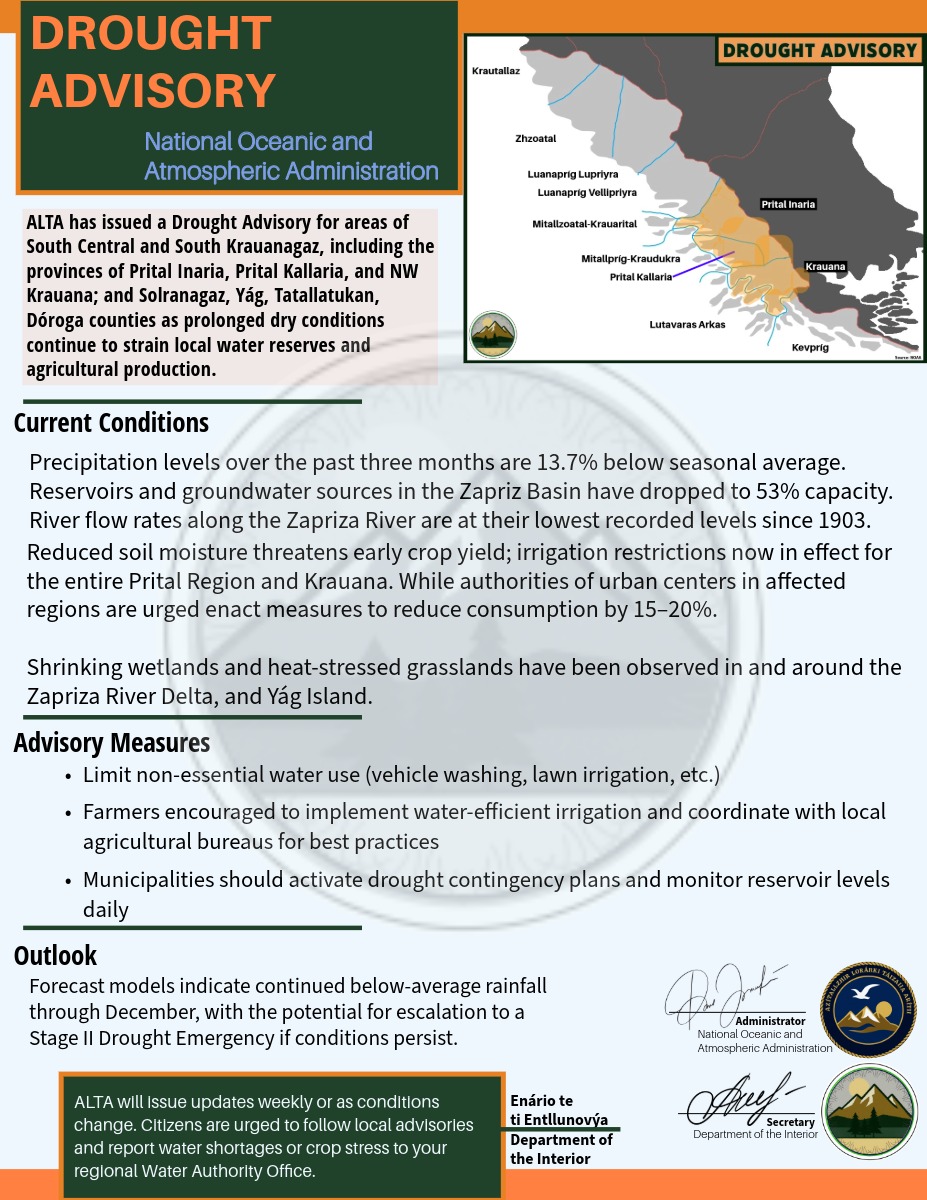
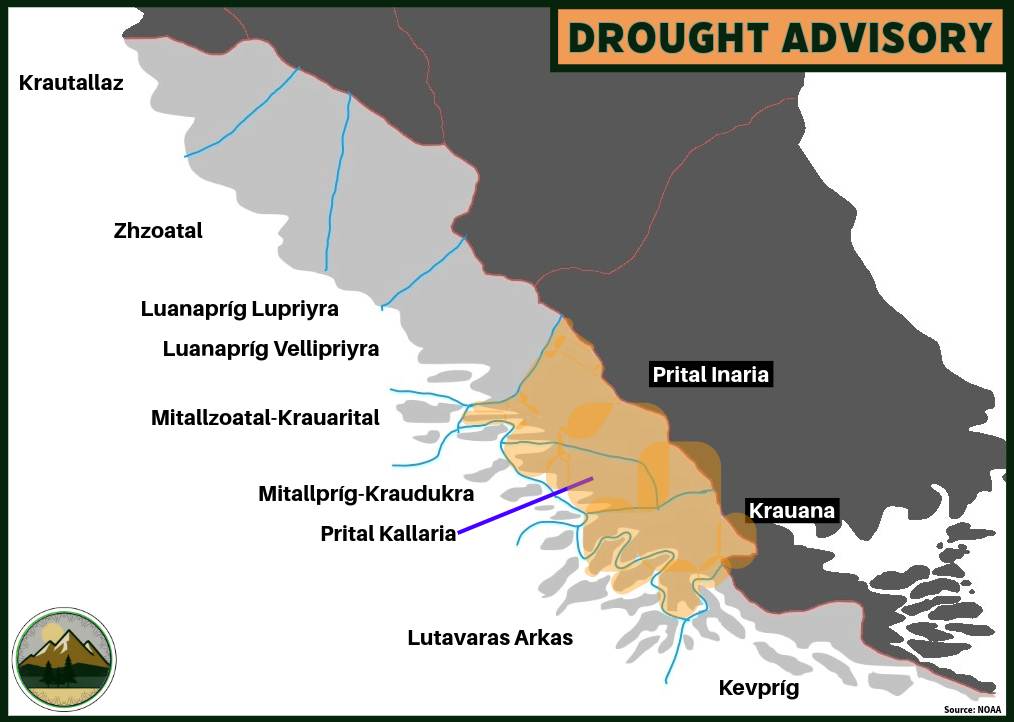
ALTA has issued a Drought Advisory for areas of South Central and South Krauanagaz, including the provinces of Prital Inaria, Prital Kallaria, and NW Krauana; and Solranagaz, Yág, Tatallatukan, Dóroga counties as prolonged dry conditions continue to strain local water reserves and agricultural production.

Current Conditions

Precipitation levels over the past three months are 13.7% below seasonal average. Reservoirs and groundwater sources in the Zapriz Basin have dropped to 53% capacity. River flow rates along the Zapriza River are at their lowest recorded levels since 1903. Reduced soil moisture threatens early crop yield; irrigation restrictions now in effect for the entire Prital Region and Krauana. While authorities of urban centers in affected regions are urged enact measures to reduce consumption by 15–20%.

Shrinking wetlands and heat-stressed grasslands have been observed in and around the Zapriza River Delta, and Yág Island.

Advisory Measures

  • Limit non-essential water use (vehicle washing, lawn irrigation, etc.)

  • Farmers encouraged to implement water-efficient irrigation and coordinate with local agricultural bureaus for best practices

  • Municipalities should activate drought contingency plans and monitor reservoir levels daily

Outlook

Forecast models indicate continued below-average rainfall through December, with the potential for escalation to a Stage II Drought Emergency if conditions persist.

ALTA will issue updates weekly or as conditions change. Citizens are urged to follow local advisories and report water shortages or crop stress to your regional Water Authority Office.

2 Likes

2024 National Biodiversity Report

Prepared by: Environmental Protection Agency & National Institute for Ecological Studies


1. Executive Summary

Overview:
The 2024 National Biodiversity Report presents an updated assessment of the biological richness and ecological health of the Krauanagaz Federation. It highlights progress in habitat restoration, species recovery, and climate adaptation initiatives, while addressing ongoing threats such as drought, land degradation, and invasive species expansion.

Key Figures:

  • Total recorded species: 58,694
  • Newly described species: 201
  • Threatened species: 18.7% of total assessed
  • Protected area coverage: 27.4% of national territory
  • Biodiversity Health Index: 72/100 (change of +3.7% since last assessment)

2. Introduction

  • Purpose and Scope:
    This report serves as the national reference document for biodiversity assessment and monitoring under the Federation’s Environmental Resilience Strategy (FERS 2030) — a long-term framework aimed at ensuring sustainable ecosystems, resilient landscapes, and adaptive management in response to climate change. It provides a comprehensive overview of the nation’s biological wealth, tracks progress toward national and international conservation targets, and identifies emerging threats to ecological stability.

The scope of this report extends beyond species inventories to include ecosystem functionality, genetic diversity, and the interactions between human activity and natural habitats. It integrates ecological data from all recognized biogeographic zones, including the Luzayyagaz Highlands, known for their endemic alpine flora; the Krautallaz Plains, which support extensive grassland and agricultural mosaics; and the Southern Steppes, home to semi-arid, tropical, and maritime ecosystems undergoing rapid desertification pressures.

  • Methodology:
    Biodiversity data was compiled through a combination of remote sensing analysis, community-based monitoring, and long-term ecological field surveys coordinated by EPA regional offices. High-resolution satellite imagery provided updated land-cover classifications, enabling precise mapping of habitat changes, deforestation, and fragmentation patterns.

Field data was collected through standardized transects, camera traps, acoustic monitoring, and DNA barcoding, where applicable. Collaboration with academic institutions, indigenous community councils, and local conservation organizations ensured the integration of traditional ecological knowledge (TEK) alongside modern scientific metrics.

Species assessments were conducted using the Krauanagaz Red Index (KRI), which evaluates extinction risk based on population trends, habitat extent, and known ecological pressures. KRI scoring also contributes to FERS 2030 biodiversity indicators, ensuring alignment between conservation reporting and policy implementation.

  • Geographic Coverage:
    The national biodiversity assessment spans 11 major ecoregions, each defined by distinct climatic, topographic, and biological characteristics.
  1. Luzayyagaz Alpine Belt – High-elevation tundra and rocky grasslands supporting cold-adapted flora and endemic ungulates.

  2. Kraanú Wetlands – Vast freshwater marshes and riparian systems critical for migratory waterfowl and amphibians.

  3. Northern Steppe Arid Zone – Semi-arid ecosystems experiencing significant water stress and soil degradation.

  4. Luprila Plains – Productive grassland biomes interspersed with agricultural lands and fragmented woodland patches.

  5. Northern Maritime Forests – Old-growth temperate rainforests along the base of much of the Luzayyagaz Range, serving as carbon sinks and refuges for avian diversity.

  6. Tirnaya Mangrove Complex – Estuarine and mangrove systems that act as natural buffers against coastal erosion and nurseries for marine life.

  7. Kevan Basin – Lowland floodplains supporting rare wetland species and essential freshwater fisheries.

  8. Pritulik Riverine Corridor – Biodiversity corridor linking inland forest systems to coastal deltas.

  9. Zhrana Highland Ridge – Transitional ecosystems between temperate and montane zones, with unique endemic plant assemblages.

  10. Southern Steppe-Oasis Region – Desert-edge habitat sustaining specialized flora and migratory herds.

  11. Star-Central Tropical Rainforest Zone – Two comparatively small but ecologically vital regions of humid forest and dense canopy, rich in amphibian, insect, and orchid species.

Together, these ecoregions form the ecological foundation of Krauanagaz’s natural heritage. The report emphasizes that conservation outcomes depend on maintaining connectivity between these landscapes, protecting keystone species, and integrating ecosystem-based management across political and administrative boundaries.


3. National Biodiversity Overview

3.1 Species Richness

The biodiversity of the Krauanagaz Federation remains among the most varied in Southern Cordilia, reflecting the nation’s wide ecological range—from alpine tundra and tropical rainforests to arid steppe and coastal mangrove systems. The 2024 assessment records notable improvements in species documentation and classification, with 201 newly described species, many of which are invertebrates and vascular plants discovered in the Star-Central Tropical Rainforest Zone and Tirnaya Mangrove Complex.

While overall biodiversity health has improved since the 2023 report, driven by targeted restoration and conservation programs, certain taxonomic groups —particularly amphibians and freshwater fish— remain under significant pressure from habitat degradation, water scarcity, and pollution events in the Kevan Basin and Tatallagaz Arid Basin.

Taxonomic Group Total Species Endemic Threatened (count / %) Change (vs. 2023 Report)
Mammals 550 42 138 (25.1%) −0.9%
Birds 1,450 120 218 (15.0%) −0.5%
Reptiles 800 96 176 (22.0%) +1.2%
Amphibians 1,194 78 478 (40.0%) −2.1%
Fish 9,000 1,100 1,980 (22.0%) +0.8%
Invertebrates 34,500 4,200 5,762 (16.7%) +2.3%
Plants & Fungi 11,200 2,900 2,218 (19.8%) +1.5%
Total 58,694 8,536 10,970 (≈18.7%)

Note: “Change” refers to variation in total species recorded, indicating an improvement in data coverage or discovery rather than population growth.

Species distribution reflects both natural patterns and anthropogenic influence. Endemism remains concentrated in mountainous and tropical zones—particularly in the Luzayyagaz Highlands, Zhrana Ridge, and Star-Central Tropical Forests—where isolation and microclimatic diversity drives speciation. Conversely, threatened species are disproportionately concentrated in lowland and semi-arid regions, where drought and agricultural expansion continue to alter native habitats.

3.2 Ecosystem Diversity

Major Ecosystem Types:

  1. Luzayyagaz Alpine Forests and Glacial Valleys – Characterized by coniferous forests, alpine meadows, and cold-adapted shrublands supporting endemic ungulates, carnivores, and high-elevation bird species.

  2. Luprila Temperate Grasslands – Fertile plains dominated by mixed-grass prairies and fragmented woodland patches; crucial for pollinators and migratory grazers.

  3. Tatallagaz Arid Basin and Salt Flats – Harsh semi-arid region with specialized halophytic vegetation and unique reptilian diversity; ongoing studies indicate expanding desertification.

  4. Kraanú Wetlands and Estuarine Systems – Complex wetland network supporting amphibian diversity and seasonal bird migration; restoration efforts have stabilized key floodplain habitats.

  5. North Coast Maritime Forests – Moist, temperate rainforests at the base of the Luzayyagaz Range acting as vital carbon sinks and strongholds for avian biodiversity.

Newly Identified Habitats:

  • Intertidal Coastal Ocean Mangrove-Fringe Lagoons – Shallow coastal lagoons identified near the Krauanai and Takara deltas, serving as critical juvenile fish and crustacean nurseries.

  • Luzayyagaz Subnival Lichen Fields – Recently mapped alpine microhabitats dominated by cold-resistant lichens and mosses, representing early indicators of climate change effects.

  • Urban Riparian Corridor Clusters - Emergent green corridors in several major urban centers.


4. Threatened and Endangered Species

4.1 Overview

The Krauanagaz Federation’s ecological diversity, spanning alpine tundra, arid steppes, temperate forests, and coastal wetlands, supports a wide range of endemic species found nowhere else in Cordilia. However, rapid urbanization, climate anomalies, and habitat fragmentation continue to place significant pressure on wildlife populations.

As of the 2025 National Red Index, 87 species are classified as Critically Endangered, 131 as Endangered, and 203 as Vulnerable. This section highlights representative taxa across key bioregions, emphasizing those of ecological, cultural, or economic significance.

Ongoing national initiatives, including the Federal Conservation Corridors Program (FCCP) and Community Biodiversity Stewardship Fund, aim to mitigate biodiversity loss through habitat restoration, anti-poaching enforcement, and local livelihood incentives.

4.2 Highlights

Critically Endangered

Luzayyagaz Snow Lynx (Lynx luzayya)
Confined to isolated ridgelines in the Luzayyagaz Highlands, this apex predator occupies one of the harshest habitats in South Cordilia. Fewer than 60 individuals remain due to glacial retreat, overgrazing of prey territories, and encroachment from expanding mining operations. Conservation strategies include establishing transboundary wildlife corridors linking the Luzayyagaz peaks with lower montane forests, and pilot livestock compensation schemes to reduce retaliatory killings. Genetic diversity remains a key concern; a captive-breeding feasibility study is underway at the National Zoological Institute.

Tideglow Mangrove Jellyfish (Aurelia littoralis)
Known locally as the Sea Lantern, this bioluminescent jellyfish creates ethereal blue-green glows during nocturnal high tides in southern estuarine mangroves. Populations have plummeted due to nutrient runoff, microplastic contamination, and coastal development. The Tirnaya Lagoon Restoration Initiative (TLRI), launched in 2023, has begun mangrove replanting and pollution control programs, with early signs of improved juvenile recruitment. The species is also culturally significant in coastal folklore and eco-tourism.

Endangered

Mitallduk Sand Antelope (Gazella kordilensis)
A flagship species of the Southern Steppe-Oasis Region, the Sand Antelope once roamed widely across Mitallduk and southern Krauanagaz. Habitat loss from fencing, overgrazing, and aquifer depletion has reduced its range to three isolated herds totaling roughly 1,200 individuals. The Tatallagaz Basin Rewilding Program aims to restore connectivity between fragmented populations through managed land corridors and community-led grazing management.

Luzayyagaz Mountain Cat (Felis altimontis)
Endemic to alpine cliffs and meadows above 2,500 meters, this reclusive feline is under severe threat from poaching for its thick, patterned fur and degradation of its highland hunting grounds. Community watch networks and drone-assisted surveillance introduced in 2024 have reduced illegal activity by an estimated 28%, but population data remain incomplete.

Silvercrest Lynx (Lynx argentatus)
A solitary, silver-gray predator that inhabits subalpine forests between 1,800–3,200 meters. The Silvercrest Lynx serves as a top-down regulator of rodent and hare populations. Forest fragmentation and development pressures in the Krautali–Zhrana foothills are major threats. Long-term monitoring under the Forest Sentinel Network seeks to map genetic connectivity between subpopulations.

Whispering Pine Toad (Bufo susurrus)
Named for its delicate, whisper-like call, this amphibian resides in high-altitude wetlands fed by snowmelt. It is particularly vulnerable to temperature rise and acidification of mountain springs. Its decline has broader ecological implications, as it serves as a sensitive indicator of water quality. Conservationists have introduced artificial spawning pools in affected regions to stabilize breeding cycles.

Vulnerable

South Cordilian River Crane (Grus rulcordil)
A migratory bird dependent on seasonal floodplains, the River Crane has declined by over one-third in the last decade. Restoration of 22 km² of wetland habitat under a joint EPA–Aduban Society project has yielded early population gains. Researchers are studying migratory behavior using satellite tagging to better understand cross-border ecological dynamics.

Golden-Plumed Krautali Eagle (Aquila krautalensis)
A revered symbol of Krauanagazan folklore, the Krautali Eagle nests on high cliffs and preys on hares and marmots. Deforestation and poaching have led to a population decline exceeding 40% since 1990. Current recovery plans involve cliffside nesting protection zones and anti-poaching patrols supported by the National Park Service.

Ember-Throated Rock Lizard (Lacerta ignisgula)
Found along sun-warmed escarpments and rocky outcrops, this small reptile’s crimson throat patch is used in mating displays. While locally abundant, its range is shrinking due to rock quarrying and illegal pet trade. Environmental education programs in South Luanapríg Province are working to discourage wild capture.

South Cordilian Mountain Elk (Cervus glacialis)
This majestic elk, identifiable by its snow-white mane, roams high-altitude valleys near glacial streams. Once near extinction, strict hunting bans and rewilding efforts since 1997 have allowed populations to rebound to sustainable levels. The species now serves as a model for long-term ungulate recovery across Cordilia.

Luzayyagaz Crimson Tree Frog (Hyla rubriventris)
A vividly colored amphibian found in lowland riparian forests, the Crimson Tree Frog acts as an indicator of local air and water quality. Deforestation and the spread of chytrid fungus via the amphibian trade are its main threats. A biosecure breeding program launched in 2022 aims to restore wild populations in the southern rainforests.

Recovered

Krautallaz Steppe Wolf (Canis cordiliensis)
Once extirpated, the Steppe Wolf was successfully reintroduced under the Wild Steppe Recovery Program (2021). Current monitoring confirms four subpopulations totaling approximately 320 individuals. The program is credited with restoring ecological balance by controlling herbivore populations and fostering grassland regeneration in Southern Mitallduk and Northern Krauanagaz.

Other Notable Listings

Near Threatened:

  • Tirnaya Mangrove Otter (Lutra tirnaya) – Semi-aquatic predator benefitting from new boating restrictions and mangrove restoration.

  • Great Horned Ibex (Capra montisgigantis) – Population stabilizing due to hunting quotas and cross-border alpine corridor protection.

  • Whisperleaf Hare (Lepus silvafolium) – Adapted for cold alpine scrublands; threatened by invasive predators and shrinking tundra zones.

  • Luzayyagaz Ice Moss (Bryum glacialis) – Vital for early soil formation; faces rapid decline from glacier retreat and reduced snowpack.

Data Deficient

  • Zhrana Ground Monitor (Varanus zhranensis) – Rediscovered in 2023 after presumed extinction. Current surveys in montane scrublands seek to establish its range and ecological role.

4.2 Population Trends

Observation:
Endemic species remain disproportionately vulnerable within fragmented or degraded habitats, particularly in agricultural frontier provinces such as southern Krautallaz and eastern Tatallagaz. Habitat isolation, combined with increased drought frequency, continues to accelerate decline rates for small and range-restricted taxa.

Trend Summary:

  • Mammals show an overall +1.2% stabilization since 2023, largely driven by carnivore reintroduction programs.
  • Amphibians exhibit a −3.4% population decline, linked to water quality degradation and chytrid fungus spread in the Kevan Basin.
  • Wetland birds (e.g., Grus zaprizi) show minor recovery (+0.8%) in rehydrated zones.
  • Pollinator invertebrates report a +1.6% gain, attributed to pesticide regulation and native flora restoration in Luprila.
  • Freshwater fish populations are −2.1% lower, with concentrated losses in arid and saline basins.

Population Trends of Selected Flagship Species (2020–2024)

Species 2020 2021 2022 2023 2024 % Change
Lynx luzayya 72 68 65 61 58 −19%
Gazella kordilensis 1,200 1,230 1,270 1,320 1,380 +13%
Grus zaprizi 880 860 850 865 890 +1%
Canis cordiliensis 180 240 290 320 +78%
Lutra tirnaya 410 420 435 460 490 +19%
Varanus zhranensis 42 58 63 N/A

Interpretation:
While species recovery programs are yielding measurable gains for select carnivores and wetland birds, amphibian and freshwater taxa remain under acute stress. The data underscores the need for sustained investment in landscape connectivity, water resource management, and community-led conservation, particularly in the semi-arid central provinces most affected by climate-driven habitat loss.


5. Key Findings and Trends

Recent ecological assessments conducted across the Luzayyagaz region and adjoining steppe, forest, and coastal biomes reveal concerning yet actionable trends. These findings underscore the interconnected challenges of climate change, land-use pressure, and biodiversity loss affecting both upland and lowland ecosystems.


5.1 Habitat Loss

Since 2020, satellite and ground-based analyses indicate an estimated 18–23% decline in steppe grassland cover, largely driven by agricultural expansion, unsustainable grazing, and urban encroachment along transportation corridors. Fragmentation of the steppe has disrupted the migration patterns of several keystone species, including the Great Horned Ibex and Whisperleaf Hare, and has reduced native seed dispersal zones.

  • Consequences: Decline in native grass and forb diversity, soil erosion, and reduced carbon sequestration potential.

  • Mitigation Efforts: Restoration pilot projects in northern Krautali and the Luzayya foothills are testing rotational grazing systems and native grass reseeding programs, showing early signs of habitat recovery.


5.2 Climate Impacts

The Luzayyagaz Mountains are experiencing accelerated warming, with average annual temperatures rising 1.6°C above mid-century norms. This has caused the range contraction of alpine flora, including the Luzayyagaz Ice Moss (Bryum glacialis) and high-altitude lichens, which now occupy zones several hundred meters higher than recorded a decade ago.

The shrinking snowpack and glacial retreat have also diminished cold-water habitats vital for the Whispering Pine Toad and other amphibians. Shifts in flowering periods are also affecting pollinators like the Luzayyagaz Nighthawk Bat and Starspotted Moth. Research initiatives are underway to identify climate refugia— microhabitats capable of supporting displaced alpine species— and to integrate these into future protected area boundaries.


5.3 Invasive Species

The spread of Akrin Mossweed (Serrata akrinensis), a highly adaptable invasive plant species, has accelerated over the past five years. It now occupies three new river basins, displacing native aquatic vegetation and altering sedimentation dynamics.

Dense mats of decaying Akrin Mossweed reduce oxygen levels in water, affecting fish and amphibian populations. Its aggressive root systems also choke native reeds and grasses essential to wetland birds. Bio-control trials involving native leaf-feeding insects and manual removal programs have been implemented in two affected watersheds, with moderate success. A national study has been commissioned to investigate effective mitigation methods.


5.4 Water Stress

Hydrological surveys report a 12–15% decrease in annual rainfall across southern provinces, with the most severe impacts observed in the Prital lowlands and Krauana. Reduced rainfall and increased evapotranspiration have accelerated ecosystem desiccation, threatening both steppe and tropical wetland biodiversity.

As a result, seasonal wetlands that once supported migratory waterbirds have dried prematurely. Riverine species such as the Mangrove River Otter and the Luzayyagaz Crimson Tree Frog face shrinking habitats and increased interspecies competition for water. Regional water-sharing frameworks are being revised to prioritize ecological flow maintenance, while new wetland restoration zones are being established in the southern Luzayyagaz basin.


5.5 Pollution Indicators

Recent data show a slight but measurable decline in water quality across four major river systems, including the Sentro, Tikhir, and Mitallana basins. Primary pollutants include agricultural runoff, industrial effluents, and microplastics originating from urban areas.

Rising nutrient loads have triggered eutrophication in lower basins, endangering aquatic species and reducing oxygen levels. Amphibian deformities and fish population declines have been noted in several monitoring stations. The Krauanagaz Federation Water Authority has expanded water quality testing sites and introduced stricter discharge regulations. Pilot wetland filtration systems near the Kevan delta show promise in improving downstream water quality.


5.6 Overall Assessment

The combination of habitat fragmentation, invasive species expansion, and climatic stressors is transforming the ecological character of the Luzayyagaz region. Yet, emerging conservation programs, particularly those emphasizing cross-ecosystem connectivity and community-managed restoration, offer pathways toward ecological resilience. Coordinated management across upland, steppe, and mangrove systems remains essential to sustaining biodiversity and ecosystem services over the coming decades.


6. Conservation Actions and Success Stories

6.1 Overview

Over the past five years, the Krauanagaz Federation has made measurable progress in biodiversity conservation and habitat restoration through coordinated government policy, local stewardship, and innovative ecological management practices. These initiatives, undertaken under the umbrella of the Federation’s Environmental Resilience Strategy (FERS 2030), demonstrate the growing integration of science-based management and community-led conservation.

6.2 New Protected Areas

Luprila Plains Wildlife Refuge (12,800 ha)
Established in 2023, this sanctuary protects one of the last intact expanses of temperate steppe grasslands in central Krautallaz Province. Once heavily degraded by overgrazing, the Luprila Plains are now the focus of intensive grassland restoration, reintroducing native perennial grasses and controlling invasive species.

  • Key species protected: Mitallduk Sand Antelope (Gazella kordilensis), Great Bustard (Otis magnus), and Ember-Throated Rock Lizard (Lacerta ignisgula).
  • Notable achievements: Early monitoring indicates a 17% increase in bustard nesting success since protection measures were introduced.

Mount Zhrana Biosphere Reserve (7,400 ha)
Designated in 2024 as the first alpine ecosystem reserve under local co-management, Mount Zhrana serves as a model for integrating indigenous stewardship into highland conservation. The reserve encompasses montane forests, glacial valleys, and alpine meadows, providing critical refuge for cold-adapted and endemic species such as the Silvercrest Lynx (Lynx argentatus) and Luzayyagaz Ice Moss (Bryum glacialis).

The Zhrana Clan Highland Council co-manages the reserve with the EPA, overseeing trail zoning, sustainable tourism, and habitat restoration. Reduction in illegal logging and poaching incidents by over 40% within the first year of enforcement (2019).


6.3 Community-Led Programs

Mitalldukish Forest Cooperatives
Across the Luprila Plains and Northern Maritime Forests, community forest cooperatives have taken the lead in expanding native tree nurseries and implementing climate-adaptive forestry practices. The initiative emphasizes the use of native hardwoods— particularly oak, fir, and luz pine species— to strengthen biodiversity corridors and improve watershed health.

Over 1.2 million seedlings have been planted since 2021, with survival rates exceeding 80% in monitored zones. Traditional ecological knowledge (TEK) guides reforestation design, ensuring restoration aligns with local cultural values and sustainable harvest practices.

Steppe Herders’ Rotational Grazing Zones
In partnership with the Department of Agriculture, steppe herders across northern provinces have voluntarily established rotational grazing systems that reduce pressure on overused pastures. Grass recovery plots and native forb reseeding are helping restore degraded rangelands while maintaining pastoral livelihoods.

Since its implementation in 2018, over 320 herder families are now participating, with satellite imagery showing a 10–15% increase in vegetation cover in pilot zones. The cooperative grazing charters link ecological restoration with income stability through sustainable certification programs.


6.4 Restoration Efforts

Under the Green Horizon Initiative (2021–2025), a total of 46,000 hectares have been rehabilitated across diverse ecosystems— from the coastal mangroves and wetlands to upland grasslands and arid basins.

  • Major activities: Replanting of native species, soil stabilization, and invasive species removal.
  • Highlights:
    • Tirnaya Mangrove Complex saw the successful reestablishment of Rhizophora luzayyaensis mangroves across 1,200 ha.
    • Southern Steppe-Oasis Region restoration has reduced dust storm frequency by an estimated 8% since 2022.
  • Future goals: Expand restoration coverage to 75,000 ha by 2027, focusing on areas of high ecological connectivity.

6.5 Reintroduction Programs

Krautallaz Steppe Wolf (Canis krautallazensis)
Once nearly extirpated due to overhunting and habitat loss, the Steppe Wolf is making a tepid return through a monitored reintroduction project led by the National Institute for Ecological Studies. Packs released in the North Krauanagaz and South Mitallduk regions are showing encouraging breeding behavior, contributing to balanced herbivore populations.

Current population estimates show 42 individuals across three confirmed territories. Continued conflict with livestock owners remains a serious management concern, mitigated through compensation programs and non-lethal deterrents.

Blue-Tailed Eagle (Aquila caerulocauda)
Reintroduction of this apex predator, extinct in parts of Krauanagaz since the 1980s, began in 2022. Captive-bred juveniles are being released into restored forest-steppe transition zones near the Luzayyagaz Range, where prey populations have recovered.

In the 2024 survey, nine breeding pairs were recorded, marking the first successful nesting in over four decades. Restoration of top-down control in steppe ecosystems by reintroducing tertiary consumers, promoting biodiversity and robust prey population balance.


6.6 Outlook

The successes documented in this section underscore the growing resilience of Krauanagaz’s natural systems when conservation is rooted in local participation, habitat connectivity, and adaptive management. These programs provide replicable models for regional cooperation, bridging the gap between scientific conservation planning and the lived practices of communities that depend on healthy ecosystems for their survival.


7. Policy and Governance

7.1 Overview

The governance framework for biodiversity protection in the Krauanagaz Federation has undergone significant strengthening in recent years, driven by legislative reform, international collaboration, and increased funding under the Federal Environmental Resilience Strategy (FERS 2030). The combination of federal mandates, provincial initiatives, and community-based enforcement mechanisms has created a more cohesive structure for conservation management and ecological oversight.


7.2 Recent Legislation

National Biodiversity Defense Act (Amendment, 2024)
The 2024 amendment represents a major step forward in the legal protection of sensitive ecosystems. It introduced formal criteria for identifying and designating Critical Ecological Zones (CEZs)— habitats deemed essential for national biodiversity stability or species survival. CEZ designation allows for rapid-response protections, including restrictions on development, mining, or agricultural expansion.

  • Key provisions:
    • Legal recognition of CEZs within all 11 provinces nationwide.
    • Mandatory environmental impact assessments (EIAs) for projects within 25km of a CEZ.
    • Establishment and empowerment of the Federal Ecological Security Commission (FESC) to enforce emergency moratoriums in ecologically sensitive areas.
  • Impact: Since enactment, 12 CEZs have been formally designated, covering approximately 9,600 km², including the Luzayyagaz Alpine Belt and Tirnaya Mangrove Complex.

Wildlife Trade Regulation Directive (1989)
Originally enacted in 1989, this presidential directive remains a cornerstone of Krauanagaz’s efforts to combat illegal wildlife trade and trafficking. It created federal enforcement units within the Department of the Interior and the Environmental Protection Agency tasked with regulating trade, transport, and export of protected species.

  • 2024 developments: A new digital permitting system was implemented, improving traceability and reducing permit fraud by 62%.
  • Coordination: The directive aligns with regional agreements under the South Cordilian Wildlife Trade Compact (SCWTC), facilitating shared knowledge with Mitalldukish and Zuhlgani authorities.

7.3 International Cooperation

Krauanagaz continues to strengthen its role as a regional leader in transboundary conservation and ecosystem monitoring.

  • Joint Species Monitoring Programs: Ongoing collaboration with Mitallduk focuses on the Luprila Grasslands and Kevta-Mitayyal Wetlands, which serve as shared habitats for migratory cranes, waterfowl, and amphibians. Joint surveys have standardized monitoring protocols across borders and established a shared species database.
  • Okhoa–Krauanagaz Marine Corridor Initiative: A new partnership established in 2023 aims to coordinate marine biodiversity assessments in the Gulf of Good Omen, addressing shared challenges such as overfishing, coral bleaching, and marine pollution.

Department of the Interior - Environmental Protection Agency

1 Like

Enário te Temivenzhir

Department of State
Diplomatic Communique
For Immediate Release


The Krauanagazan government wishes to convey deep dismay at Izaakia’s decision to evacuate nonessential personnel from the Izaakian Embassy in Yayyára. Krauanagaz remains committed to ensuring the safety and security of all diplomatic missions and visitors within our borders.

We do understand the concerns held by Izaakia regarding ongoing protests in Yayyára. Rest assured, the Krauanagazan government is taking proactive measures to ensure any public gathering near consulates or embassies remains peaceful. We remain fully committed to upholding obligations under international law to protect all foreign nationals within Krauanagaz and maintaining the safety of diplomatic missions.

We urge Izaakia, and all other nations, to continue engaging with us diplomatically to address any concerns so we may work collaboratively towards finding amicable, peaceful solutions. Krauanagaz remains open to constructive dialogue and cooperation with the international community to ensure the safety and well-being of all persons, regardless of nationality.

Signed,

Enário te Temivenzhir
Darius Korin

@Izaakia

1 Like

Zhirveniayya Temipre te Kallzhir Uvenital

Federal Human Rights Commission
2025 Annual Update to the Pacifica Classification System for Human Rights and International Law Adherence


The Krauanagazan Federal Human Rights Commission (KFHRC) today released the 2025 annual update to the Pacifica Classification System for Human Rights and International Law Adherence, the region’s most comprehensive framework for assessing nations’ commitments to international legal and human rights standards.

Developed and maintained by the KFHRC since its inception in 2024, the classification system evaluates all recognized nations through a rigorous, evidence-based process designed to foster accountability, transparency, and respect for human dignity. The 2025 update reflects the Commission’s continued mission to promote a rules-based regional order grounded in universal principles of justice, equality, and the protection of individual freedoms.

Key Highlights from the 2025 Update

The new classification cycle integrates extensive data from civil society organizations, international monitoring bodies, academic institutions, and national governments. Several adjustments have been made to reflect evolving human rights conditions across Pacifica:

Advancements in Compliance: A number of nations have improved their standings due to measurable progress in judicial independence, expansion of civil protections, and enhanced cooperation with international human rights mechanisms.

Emerging Areas of Concern: The Commission identified deteriorations in civil liberties, minority rights, and press freedom in several states, marking the first recorded overall decline in regional human rights adherence.

Public Health and Humanitarian Policy: Following regional crises, including the spread of Cordilian Fever, the Commission noted widespread concerns regarding the use of coercive or extrajudicial measures under the guise of public health enforcement. These findings prompted additional scrutiny of emergency powers and government transparency in affected nations.


Statement from the High Commissioner for Human Rights:

This year’s update underscores both the progress and peril within our region. While many nations have reaffirmed their dedication to human rights and international law, others have drifted toward secrecy, exclusion, and repression. The Commission’s responsibility is not only to report these trends but to promote constructive engagement and reform. Our message remains clear: adherence to international law is the foundation of peace and prosperity across Pacifica. The classifications are not meant as a punitive measure, they are there to serve as a diagnostic tool to guide policy reform, encourage good governance, and empower citizens and civil organizations to hold their governments accountable.


There are seven classes to which a nation may be assigned:

Class I - Model Adherent States
Nations in this tier consistently uphold international law and demonstrate a strong commitment to human rights. They actively participate in international agreements and treaties, maintain transparent legal systems, and protect the rights of their citizens. Model Adherent States may serve as regional benchmarks for good governance and potentially act as mentors or sponsors for technical human rights programs.

Class II - Average
Nations in this tier generally adhere to international law and respect human rights, but may face challenges or shortcomings in certain areas. They demonstrate efforts to improve their human rights record and engage in dialogue with international partners.

Class III - Transitional or Conditional States
Nations in this tier typically exhibit mixed or uneven adherence to international law and human rights standards. While formal frameworks may exist, implementation is often inconsistent, and accountability mechanisms remain underdeveloped or politically influenced. Transitional States are often priority targets for reform assistance, typically eligible for cooperative human rights programs and conditional international support aimed at institutional strengthening and legal modernization.

Class IV - State of Concern
Nations in this tier exhibit significant deficiencies in adherence to international law and protection of human rights. They may have systemic issues such as corruption, discrimination, or suppression of certain freedoms, leading to violations of human rights.

Class V - Rouge State
Nations in this tier demonstrate a clear pattern of disregard for international law and systematic violations of human rights. They may exhibit authoritarian or oppressive regimes, widespread repression of dissent, and impunity for human rights abuses.

Class VI - Law-Divergent State
Nations that demonstrate systemic and usually deliberate violations of international law and human rights obligations. These states routinely suppress dissent, engage in arbitrary detention or extrajudicial actions, and totally reject international oversight or treaty commitments. Class VI designation triggers heightened monitoring and potential international sanctions or legal actions under international law. States in this tier are urged to adopt immediate reforms or potentially face collective measures from regional or international institutions.

Class VII - Failed State
Nations in this tier have collapsed or are in a state of conflict, rendering them unable to uphold international law or protect human rights. They may experience humanitarian crises, civil unrest, or other internal conflicts, leading to widespread suffering and instability.

Classification Table
Nation Current Class Prev. Class Reclass Date Strikes Notes
Eflad Class I 3/24/24 0
Gianalta Class I 3/24/24 0
Emerald & Denver Class II 3/24/24 0.25 Restrictive Civil Liberties, Unlawful Military Action
Krauanagaz Class III Class II 11/4/25 0 Restrictive Civil Liberties, Corruption, Human Rights Violations
Mitallduk Class VII Class II 5/13/25 0 Civil War
Zhulgan Class IV 3/24/24 1 Human Rights Violations, Corruption, Restrictive Civil Liberties, Unlawful Military Actions
Izaakia Class VII Class III 11/2/25 0 Civil War
Keanu & Hurley Class III 3/24/24 0.25 Human Rights Violation
Akarina Class III Class IV 3/24/24 2 Human Rights Violations, War Crimes, Corruption
Kliegme Class II 11/4/25 0 Restrictive Civil Liberties
Sedunn Class I 3/26/24 0
Okhoa Class III Class IV 5/13/25 0 Restrictive Civil Liberties
Prydon Class II 5/13/25 0
Karnetvor Class II 5/13/25 0 Restrictive Civil Liberties
Viridia Class II 11/1/25 0
Visrodin Class III 5/13/25 0.5 Human Rights Violations, Restrictive Civil Liberties
Huawan Class III Class II 11/4/25 0 Restrictive Civil Liberties
UPRAN Class II 11/2/25 0
Past Class II 11/3/25 0
Ryccia Class III 11/2/25 0.5 Restrictive Civil Liberties
N&GB Class VI 3/24/24 1 Internationally Embargoed for Multiple Violations
Esfalsa Class I 3/24/24 0
Holy Tiribtallan Republic Class III 11/1/25 0 Restrictive Civil Liberties
Frost Empire Class III 11/2/25 0.25
Holy Free Class III 11/2/25 0
FiHami Class IV Class III 11/2/25 0.25 Restrictive Civil Liberties, Human Rights Violations
Austra Class II 11/2/25 0
Vrigny Class I Class II 11/2/25 0
Pelinai Class II 11/2/25 0 Restrictive Civil Liberties
Cadiz Class II 11/3/25 0
Stoinia Class II 11/2/25 0
Sallodesia Class II 11/2/25 0
Castemura Class III 11/3/25 0
Yttria Class II 11/3/25 0
Losrava Insufficient Data
Arfodir Class III 11/1/25 0
Aldestukk Class VI Class II 10/30/25 0.25 Restrictive Civil Liberties, Human Rights Violations
Firest Class VI Class III 10/30/25 0.5 Unlawful Military Action, Restrictive Civil Liberties, Human Rights Violations, War Crimes
Hazelia Insufficient Data
Cimbria Class II 11/3/25 0
Conaro Class II 11/3/25 0
Bersern Class I 4/11/24 0
Bruuma Class VI 11/4/25 0
Snolland 11/4/25 Insufficient Data
Sierra Ticorre Class III 11/4/25 0
Erinor & Sereva 11/4/25 Insufficient Data
Shai Kong Class II 11/4/25 0
Hai Men 11/4/25 Insufficient Data
Sanhe 11/4/25 Insufficient Data
Seleteryo 11/4/25 Insufficient Data
Struania 11/4/25 Insufficient Data
Blevaria 11/4/25 Insufficient Data
Hystagia 11/4/25 Insufficient Data
Valkyria Class III 11/4/25 0
Aberstopia 11/4/25 Insufficient Data
Kai Fa Class IV 10/3/25 0 Human Rights Violations, Restrictive Civil Liberties
Termina Class VII 11/5/25 0 Internal Civil Conflict
Weissersteiner Class III 11/4/24 0 Restrictive Civil Liberties
Puerto Pollo Class IV 10/11/25 0 Human Rights Violations, Restrictive Civil Liberties
Sugovia Class III 10/11/25 0
Fatiniyya Class III 10/19/25 0
Jakub Class II 10/19/25 0 Restrictive Civil Liberties
Tepertopia Class II 10/20/25 0 Restrictive Civil Liberties
Jäähua Class III 10/20/25 0
Nasphilitae Class III 10/20/25 0 Restrictive Civil Liberties
Alcoalitania Class II 10/20/25 0
Kalaki Class II 10/20/25 0
San Marsico Class III 5/14/24 1 War Crimes, Unlawful Military Action, Restrictive Civil Liberties
Central Bailtemmic Republic Class IV 11/5/25 0
Transsuneria Class I 0
Pekelau Class II 0
Daristowa Insufficient Data
Clashonia Class III 0.25
Delata Insufficient Data
Kustanna Class II 0
Andrendia Class II 0
Altnavia Class III 0
Terre des Gold Insufficient Data
Aqystamnyll Class III 0
Lusadao Class III 0

Same table, but on google sheets


Signed,

Zhirveniayya Temipre te Kallzhir Uvenital
High Commissioner for Human Rights
Elowen Serak

2 Likes

Enário te Temivenzhir

Department of State
Diplomatic Communique
For Immediate Release


The Krauanagazan government is deeply concerned by the recent string of events in FiHami, including inflammatory rhetoric, the unlawful nullification of international treaties, and heavy-handed policing in Ha’Hani. In response to these events, Krauanagaz is exploring the implementation of targeted economic sanctions against several political figures in FiHami. Furthermore, out of concern for the wellbeing of our citizens and diplomatic personnel, we have initiated procedures to evacuate non-essential personnel from our embassy in Ha’Hani, and other diplomatic facilities in FiHami.

We strongly urge FiHami to continue engaging diplomatically to address any concerns, and to work collaboratively with regional and international partners towards finding amicable, peaceful solutions.

Travel Advisory: Civil Unrest, High Diplomatic Tensions

Non-essential travel to FiHami is strongly discouraged at this time. Krauanagazans currently in FiHami are strongly advised to consider immediate evacuation. Report to the nearest Federation consulate or the embassy in Ha’Hani for evacuation assistance.

Extreme caution is advised, and remaining vigilant in public spaces is vital. It is also prudent to avoid participating in or approaching large gatherings, protests, or political events at this time.

Follow the FiHami Diplomatic Mission on Pasture or Stream to receive updates and emergency notifications. Emergency notifications will automatically be delivered to the mobile phones of Krauanagazans in FiHami should any be issued.


Enário te Temivenzhir

@Ray

1 Like

Temiprizhirven te ti Krauanaet

Office of the President
Live Televised Address
Transcript of Delivered Statement


Good evening. Tonight, I address the nation with deep concern and grave disappointment over the events that have unfolded in Krautallaz Province. The series of unauthorized and unlawful raids conducted by the Krautallaz Provincial Rangers in the early hours of Monday morning constitutes a flagrant violation of federal law, human rights, and the constitutional order of our Federation.

Let me be clear: nighttime immigration enforcement operations are explicitly prohibited under federal statute. These restrictions exist for good reason— because in the past, such actions have led to serious abuses by both provincial and federal personnel. What occurred on Monday night represents a stark return to those dark chapters of our history.

Reports from multiple verified sources indicate that innocent men, women, and children were forcibly removed from their shelters under the cover of darkness, detained without due process, and subjected to intimidation and humiliation. Refugees and asylum seekers— individuals who came to our nation seeking safety and dignity— were treated as subhuman. These actions are not only unlawful; they are unconscionable. The federal government was neither consulted nor informed of these operations beforehand. Had such a request reached my office, authorization would have been unequivocally denied. Governor Nimi is fully aware of this fact. His decision to proceed in secrecy only demonstrates that this was a deliberate attempt to circumvent federal authority and judicial oversight.

In recent weeks, the conduct of Governor Nimi and his administration has grown increasingly concerning. This includes the unauthorized deportation of Mitalldukish and Zuhlgani refugees and asylum seekers, in direct defiance of standing court orders. Then, following that judicial intervention, the governor’s office sought to evade compliance by forcibly relocating displaced persons to southern provinces without their consent, often without their foreknowledge of the destination, and without notification to receiving authorities. These actions undermine not only federal law but the moral foundations of our republic.

Governor Nimi’s continued defiance of federal directives and judicial rulings can no longer be tolerated. My office has issued no fewer than six formal communications to the governor in the past two weeks, all of which have gone unanswered. The Federal Police Agency has likewise issued multiple cease-and-desist orders to provincial departments since August, which have been disregarded. Now, let me remind all provincial officials: immigration policy and enforcement falls solely within the jurisdiction of the federal government. No province has the constitutional authority to enact or enforce immigration measures independently of federal oversight.

In light of these unprecedented and unlawful actions, most especially the armed confrontation with our Emeraldian partners at a World Forum–sponsored refugee camp that resulted in multiple injuries, the federal government can no longer entrust the provincial authorities with the maintenance of law and order in Krautallaz. After lengthy consultation with my Cabinet and the National Security Council, I have authorized the federalization of the Krautallaz Provincial Militia, effective immediately. Command and operational control of all provincial security units will henceforth fall under federal jurisdiction. Furthermore, pursuant to the Civil Rights Act of 1997, the Krautallaz Provincial Rangers are hereby ordered to cease all policing and enforcement operations pending a full and independent review of personnel, leadership, and policy by the Department of Justice and the Federal Police Agency. During this period, the FPA will assume interim responsibility for law enforcement and civil security throughout the province, in accordance with federal law and the protections guaranteed under the Civil Rights Act.

This is not a decision taken lightly. Federal intervention in provincial affairs is an extraordinary measure, one that speaks to the gravity of the present situation. However, the rule of law and the protection of human rights must prevail over provincial ambition and political expediency. I, tonight, also want to assure the people of Krautallaz— citizens, refugees, and residents alike— that the federal government remains steadfast in its commitment to your safety, your dignity, and your rights. We will restore order, uphold justice, and ensure accountability for all who have abused their authority.

Thank you, and may the Federation stand united in law and conscience.


Office of the President
Krauanaet Thalira Renkara