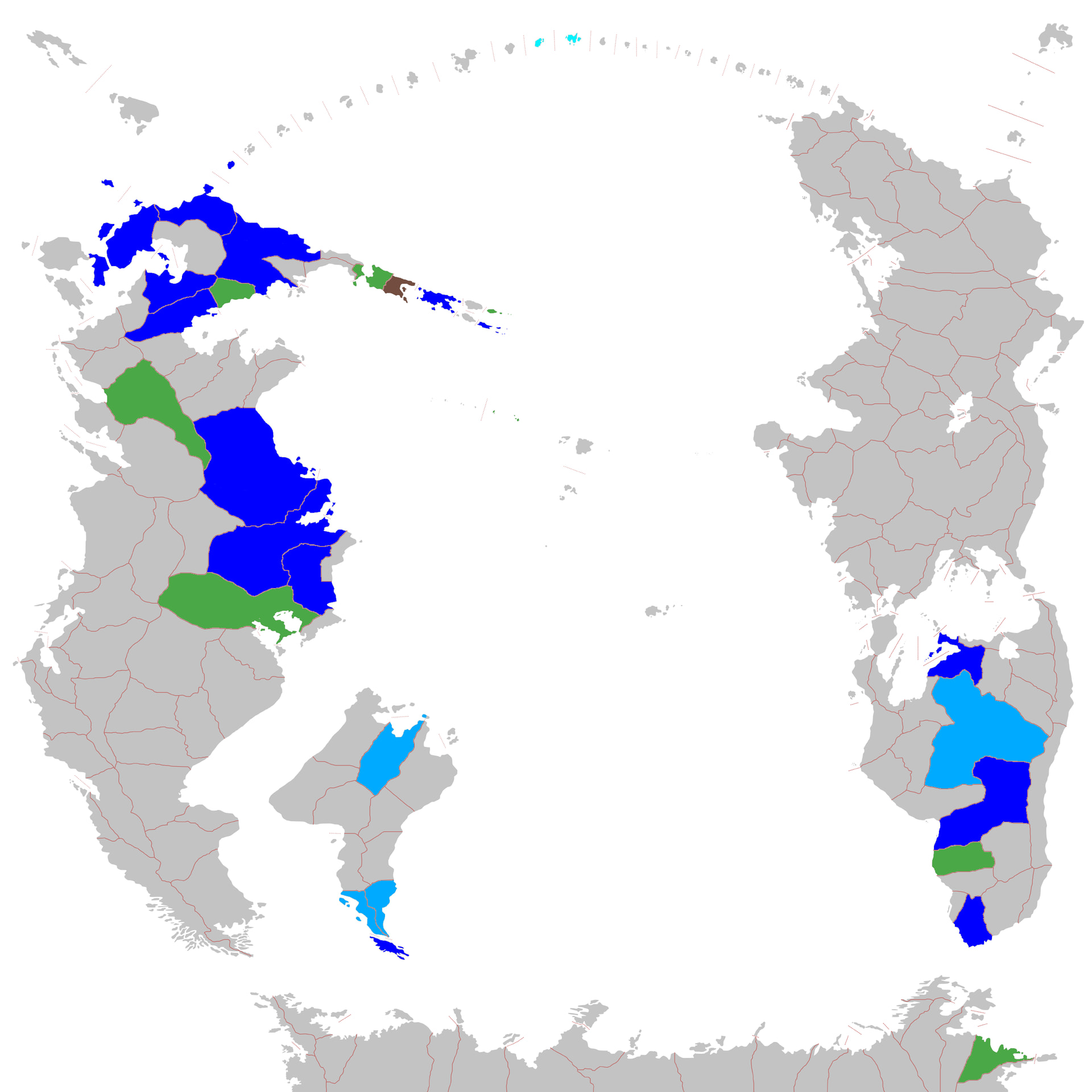
So, as we’re all pretty well aware, the Germanic (or Almannic) languages are currently among the most widely-spoken languages in Pacifica. Even if we take out Austral, that still leaves possibly more than 300 million people in Pacifica that speaks some form of Germanic language as a first language.
This opens up an incredibly interesting door for shared diplomatic, cultural, and linguistic worldbuilding among Germanic speaking countries, especially since the majority of Germanic languages seem to have its origins in Cordilia, making a shared linguistic history plausible. With that in mind, I’d like to start some form of discussion on this.
@s
I will include everyone I know of who’s country predominantly speaks a form of Germanic language (excluding Austral/English for now), or alternatively are a part of the Alman Group as either a member or observer. If you roleplay as a Germanic-speaking country but aren’t mentioned, don’t be shy to join in
So, this is the temporary classification I came up with based purely on my observations. The blue are countries that I consider to be speaking a West Germanic language (North Almannic, explanation below) and green are countries that speak a North Germanic language (South Almannic), with light blue and light green (currently none on the map) being countries with noticable Almannic minorities. I also marked Hazelia as brown because I’m not 100% sure if they fall in the Almannic category at all. Austra is highlighted in cyan (for now).
I chose the terms North and South Almannic for West and North Germanic respectively because of geography and history (that I know of). Since the West Germanic languages came to Central Cordilia from Frastinia, and later influenced the expansion of West Germanic languages into Bareland, it is safe to say that the West Germanic languages ultimately come from Frastinia, which is in the north relative to the other Almannic languages.
South Almannic, as I’ve termed it, largely stems from my understanding that both Ryccia and Valkyria are themselves quite old, meaning their language has been around for a while and were probably not as influenced by the spread of North Almannic/West Germanic languages to Central Cordilia as in countries like Weisserstein. It’s not as well defined especially because of its spread, with Cimbria and Ravensland in Frastinia, but that’s what this thread is supposed to talk about anyways.
I agree with the general classification, and I think of Frastinia as the urheimat of at least Alman, and likely the whole Almannic (i.e rl Germanic) branch.
Modern Transsunerian is very West Germanic, but it used to be its own branch parallel to West Germanic. Colonisation by primarily the Gianlucians and trade with the wider area eventually made it somewhat Dutch- and Low German-like, but still its own language. Transsunerian also has a large amount of loanwords from Sedunnic merchants who were present in the archipelago for centuries, and to a lesser degree English and Spanish due to extensive contact with the Austral Empire and Stoinia respectively.
Ahh, I knew that Transsunerian was its own thing but I’ve always assumed it meant that it is a sibling of Alman (German). If it is its own branch then I guess that means the Almannic languages could be divided up to 3–4 subdivisions.
Alternatively, Transsunerian could be a subdivision within the wider North Almannic family. So while it remains its own thing compared to, for example, standard Alman, Besernian, or Landler (spoken in Weisserstein), it is still part of the wider North Almannic umbrella.
There is a form of Frisian which actually developed from Frisian settlers from Frastinia around Gröningburg, Fauderland which likely comes from its own branch of North Almannic.
That would make a lot of sense. One of my ideas is that the North Almannic (i.e. West Germanic) language family would generally be divided into Insular North Almannic (Austral and probably other Anglic languages) and Continental North Almannic (everything else, including the other IRP North Sea Germanic languages like Frisian and Low German, even if they’re closer to the Anglic languages classification-wise). So this somewhat fits with what’s established.
Kliegme’s Alman population comes from mostly Weisserstein/Alman speaking regions near it, so it’d be reasonable for them to be linguistically similar. However, I imagine they have picked up some Garanian and Karnetvorian Loanwords and terms along the way, becoming a sub-dialect
I can’t speak for all of Bareland but Low Alman might just be the most common across the continent, in many ways it’s a more archaic form as colonial dialects tend to be. That does bring up the question would Friean (Dutch) be a Low Almannic dialect?
I’ve just realized that this discussion is actually relevant to me
Me and Weisserstein have already discussed the Losavral alman populations, which are obviously going to have had a weissersteiner dialect that is heavily modified by Indavral, perhaps even a creole.
The Nölvral Almans I planned to be related to Besern; however, Nölvra was conquered very early. This probably means that Nölvral dialects have diverged a lot, potentially into a completely different Almannic language, although there still would have been some outside contact.
That makes sense. Perhaps some Weissersteiner dialects might’ve even went overseas to Kliegme à la Germanic languages in the Americas like Hunsrik or Pennsylvanian Dutch.
Considering North Sea Germanic (Low German) and Weser-Rhine Germanic (Dutch) are technically two different subbranches of the West Germanic family, they might stay different IRP as well.
That being said, I do notice that Low Alman (spoken in Eflad) and Freian (spoken in Holy Free) are pretty close to each other, especially if we add in Besernian (which, according to the wiki, uses a hybrid of German and Dutch), it could be a “Low/Weser-Rhine” Germanic line east of the Vororrim. So perhaps, while they may or may not a “Low Alman dialect”, Friean might be related closely, especially geographically, to Low Alman and Besernian.
Speaking of, is there any lore yet about Nölvra? It’s interesting how the Indavrals and Almans kind of intertwine very often.
I think it’d be fun to have the status of Kliegmean Alman (Crabryan Alman in general) be debated academically. Some argue it is a sub-branch of the Weisserstein dialect(like Southern Bavarian in the Bavarian umbrella), while others argue it has ‘evolved’ to be a different dialect/language to its Weissersteiner counterpart due to having absorbed Karnetvorian and Garanian linguistic influences. (Like Luxemburgish and Franconian dialects)
As for now, there is lore, but it’s limited and mostly modern day stuff. The TE colonizes Nölvra very early on, fails to push far into Besern. After that, I don’t have much until the GW.
After the Great War, Nölvra was given independence. The regime was Alman-led as they were oppressed under the Father States, the Almans become increasingly dictatorial and start opressing the indavrals. During the period known as the Grand Indavral War, Ikaranara (controversially at the time) coups the regime, fights the remnants of the tiny Nölvral army, and turns it into a semi-autonomous territory. In the modern day, the ethnic tensions are mostly relieved.
Sugovia’s Alman languages are divided into multiple dialects and languages. The southern portion around the provinces of Sunland, Algaria, Alania, Esharia, Steidland, Vereden, Otfridenia, and coastal parts of Aldental and Saltzemarkt speaks dialects closer to other Alman languages in Weisserstein and is used to create Sugovian. They are known as the South Sugovian Dialects or South Sugovian Languages
The people in Moorsaha speak Moorish which is an Arabized Alman language and write using the Arabic script. Leiyern and the other parts of Aldental speaks Central Sugovian Dialects/Languages. The people in Nordmark, Zierenburg, and Hohenland speak Northwestern Sugovian Dialects/Languages. They probably have a lot of Indavral influence from the Triangular Empire
Elbonians in Heckel and Cleves speak Elbonian and considered separate from the rest of the Sugovian languages
Indeed, however if Frisian was spoken in Frastinia, it would probably fall under the Continental North Almannic classification, even if IRL Frisian is closer to English than to Dutch or German. As I said, my original idea was that North Almannic is divided into two: Insular North Almannic (which will include Austral) and Continental North Almannic (includes everything from Freian, Besernian, Alman, Transsunerian, etc.), mostly based off geography.
Also, correct me if I’m wrong, but I believe Austral IRP is actually a bit different from English as we have it in our world, though we use our version of English for convenience. If that’s the case, then classifying Austral as “distinct” from Low Alman and the IRP version of Frisian would probably be feasible.
I haven’t actually gotten around to it yet, but when I go over and revamp some parts of Nicholas and Great Britain (which will include their language), they will no longer be Austral speaking and will speak their own Germanic/Almannic language. When I first set about translating some words, I wasn’t aware or paying attention to historical shifts, and just created my own vowel and consonant shifts from proto-Germanic, so what probably most realistically happened with NaGB (which is no longer their name) is that Germanics/Almannics left their original area and settled on what is now most of NaGB quite early, so would probably be outside your original classifications.